Gurgaon has already established itself as one of India's leading corporate and commercial destinations.
What started as a major office market has evolved into a much broader real estate ecosystem comprising corporate offices, Global Capability Centres, retail destinations, restaurants, hospitality, residential communities, mixed-use developments and lifestyle spaces.
But the next phase of Gurgaon's growth may look very different from the previous one.
The commercial property of tomorrow will not simply be about square footage.
It will increasingly be about:
- Experience.
- Technology.
- Flexibility.
- Sustainability.
- Connectivity.
- Efficiency.
- Human behaviour.
This transformation is already visible across India's commercial real estate market. Office occupiers are increasingly looking for flexible and experience-led workplaces, while sustainability and technology are becoming important components of modern buildings.
For Gurgaon, these trends are particularly relevant because of its large corporate ecosystem, premium residential catchments and continuously evolving infrastructure.
So, what could commercial real estate in Gurgaon look like over the next decade?
Here are seven trends worth watching.
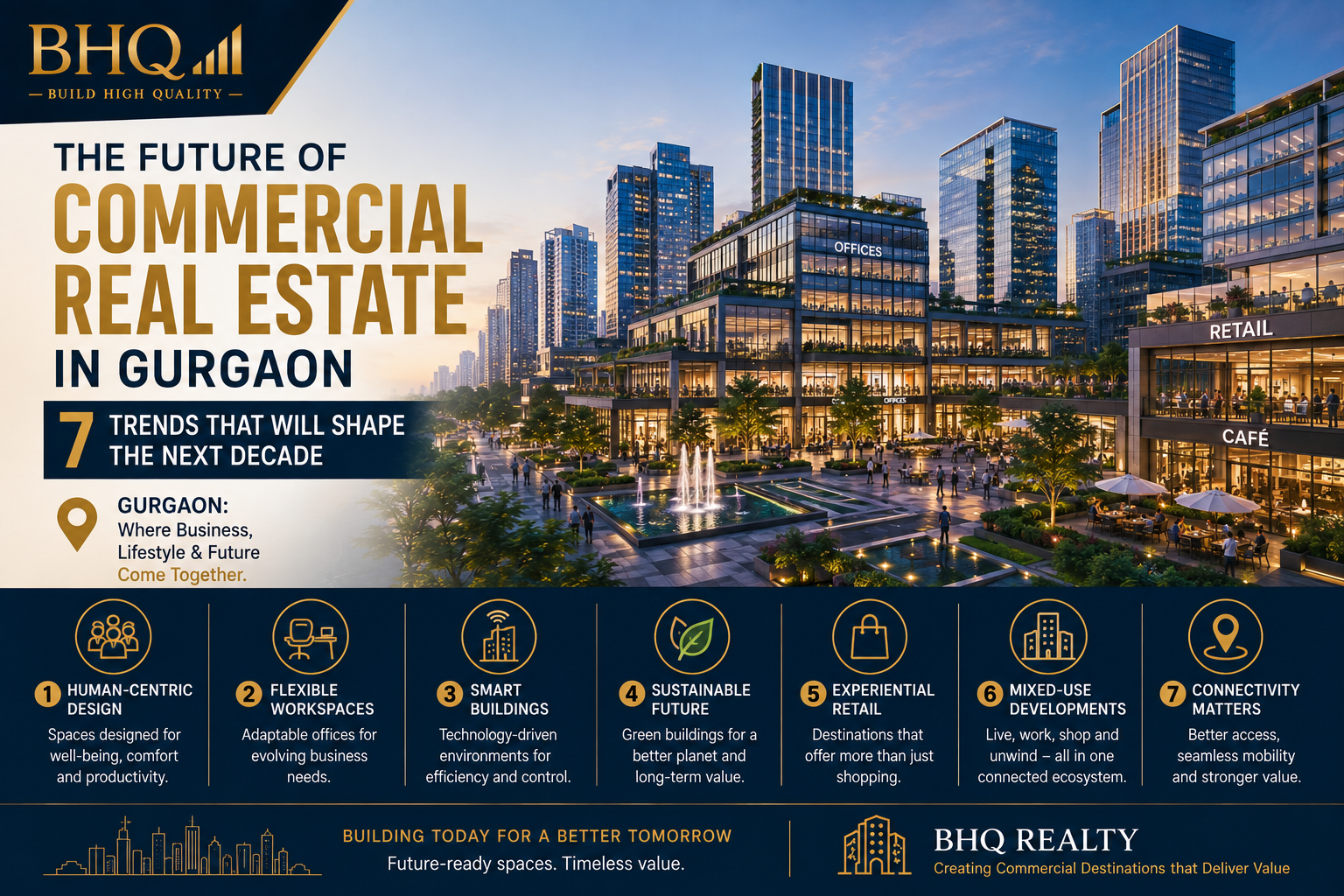
Commercial Buildings Will Become More Human-Centric
For decades, commercial real estate was largely measured in terms of:
- Floor area
- Number of floors
- Parking
- Efficiency
- Rental rates
These factors will remain important.
But modern occupiers are asking a different question:
How does the space make people feel and work?
An office building is no longer simply a collection of workstations.
Employees increasingly expect:
- Comfortable workspaces
- Natural light
- Green areas
- Cafés
- Collaboration spaces
- Wellness facilities
- Informal meeting areas
- Better indoor environments
This shift toward human-centric design is particularly relevant in Gurgaon, where businesses compete for skilled professionals.
A high-quality workplace can become part of an employer's overall employee experience.
Flexible Workspaces Will Continue to Grow
Flexible Workspaces Will Continue to Grow
The traditional model of leasing a large office for many years is no longer the only option available to businesses.
Companies increasingly want flexibility.
A growing business may need:
50 seats today → 100 seats next year → 200 seats later.
A rigid office structure can make this difficult.
Flexible workspace providers can offer:
- Managed offices
- Coworking
- Private cabins
- Meeting rooms
- Shorter commitments
- Plug-and-play infrastructure
- Expansion flexibility
Recent CBRE data showed that flexible workspace operators accounted for a significant share of office leasing activity in India during 2026.
This trend is likely to remain relevant in Gurgaon because the city's business ecosystem includes large corporations as well as startups, technology companies and growing enterprises.
Smart Buildings Will Become the New Normal
Technology is changing how buildings operate.
The next generation of commercial buildings will increasingly use digital systems to improve:
- Energy efficiency
- Security
- Parking
- Access control
- Maintenance
- Indoor air quality
- Lighting
- Temperature
- Building management
Imagine entering an office building without traditional access cards.
Or finding your parking space through an app.
Or automatically adjusting lighting based on occupancy.
Or identifying maintenance issues before they become major problems.
These are examples of how smart building technology can improve both efficiency and user experience.
For developers, the challenge will be to ensure technology is useful rather than simply decorative.
Sustainability Will Move From Feature to Expectation
Sustainability is becoming increasingly important across commercial real estate.
Businesses are becoming more conscious of:
- Energy consumption
- Carbon emissions
- Water efficiency
- Waste management
- Building materials
- Indoor environmental quality
- Corporate ESG objectives
This is particularly relevant for large corporate occupiers.
A building that operates efficiently can potentially provide benefits beyond environmental performance.
It may also contribute to:
- Lower operating costs
- Better employee experience
- Corporate sustainability goals
- Long-term asset relevance
CBRE's 2026 office data has shown strong demand for green-certified office buildings across India, reinforcing the direction of the market.
For future commercial projects in Gurgaon, sustainable design is therefore likely to become increasingly important.
Retail Will Become More Experiential
Online shopping has changed retail.
Customers can purchase almost anything from their phones.
So why visit a physical retail destination?
Because physical spaces can offer something digital platforms cannot fully replicate:
Experience.
The future of retail may increasingly combine:
- Shopping
- Dining
- Entertainment
- Wellness
- Social interaction
- Events
- Community
A customer may visit a commercial destination to have dinner, meet friends, browse products and attend an event all during the same visit.
This is why Gurgaon is seeing increasing interest in destinations that combine retail with lifestyle.
The future retail environment will likely be less about:
"Come here to buy something."
and more about:
"Come here because there is something worth experiencing."
Mixed-Use Developments Will Become More Relevant
The traditional separation between office, retail and lifestyle is becoming less rigid.
Modern commercial destinations increasingly bring multiple activities together.
A mixed-use environment might include:
- Offices
- Retail
- Restaurants
- Cafés
- Wellness
- Entertainment
- Hospitality
- Community spaces
This creates multiple reasons for people to visit.
An employee may work there.
A resident may shop there.
A family may dine there.
A professional may meet a client there.
A visitor may attend an event there.
The result is a more active commercial ecosystem.
For Gurgaon, where residential and corporate development often exist side by side, this model has significant relevance.
Connectivity Will Become More Important Than Ever
The future of commercial real estate is not only about what happens inside the building.
It is also about how easily people can reach it.
Employees want convenient commuting.
Customers want easy access.
Companies want access to talent.
Businesses want reliable logistics.
This makes connectivity one of the most important long-term commercial considerations.
Gurgaon's network of major roads, expressways and transportation corridors continues to influence the city's commercial geography.
But future projects will need to consider connectivity at several levels:
Regional connectivity
How easily can people reach the location from Delhi and other parts of NCR?
Local connectivity
How easily can employees and customers reach the property from nearby sectors?
Internal connectivity
How efficiently can people move through the development?
Digital connectivity
Does the building provide the technology infrastructure modern businesses require?
The best commercial destinations will increasingly need all four.
The Rise of Experience-Led Commercial Buildings
The commercial property of the future may look less like a traditional office block and more like a complete destination.
Imagine arriving at a development where you can:
- Work
- Meet
- Have coffee
- Exercise
- Shop
- Dine
- Attend an event
All within one connected environment.
This is not simply about adding more amenities.
It is about creating a reason to stay.
That distinction matters.
A list of amenities does not automatically create a successful commercial destination.
The amenities need to support the actual users.
What Will Tenants Expect From Future Commercial Spaces?
The expectations of commercial occupiers are evolving.
Businesses increasingly want spaces that support:
Productivity
Efficient work environments.
Flexibility
The ability to expand or contract.
Employee Experience
Comfortable and attractive workplaces.
Technology
Reliable digital infrastructure.
Sustainability
Buildings aligned with environmental objectives.
Accessibility
Easy access for employees and clients.
Brand Image
A workplace that reflects the company's identity.
This means commercial developers will need to think beyond construction.
They will need to understand the occupier's experience.
What Will Customers Expect From Future Retail Destinations?
Consumers are changing too.
A future retail customer may expect:
- Easy parking
- Digital payments
- Comfortable surroundings
- Good food
- Entertainment
- Social spaces
- Wellness options
- Events
- Strong brands
- Convenient access
This means retail projects will increasingly compete on experience and convenience, not simply store count.
A commercial destination with 100 shops is not necessarily better than one with 40 carefully selected businesses.
Tenant quality and compatibility can matter more than quantity.
Technology Will Influence Property Management
Technology Will Influence Property Management
Technology will also change what happens after construction.
Property managers can increasingly use digital systems to monitor:
- Energy
- Water
- Security
- Parking
- Equipment
- Occupancy
- Maintenance
Data can help identify patterns.
For example:
If a particular area experiences heavy traffic at a specific time, management can adjust operations accordingly.
If energy usage rises unexpectedly, building systems can flag the issue.
If equipment begins operating inefficiently, predictive maintenance systems can potentially identify the problem earlier.
This can make buildings more efficient and responsive.
Commercial Real Estate Will Become More Data-Driven
Property decisions have traditionally relied heavily on:
- Location
- Experience
- Market reputation
- Historical transactions
Data is now adding another layer.
Developers and investors can increasingly study:
- Mobility patterns
- Demographics
- Occupancy
- Consumer behaviour
- Rental trends
- Supply
- Leasing activity
- Business registrations
- Infrastructure
This can improve decision-making.
However, data should support not replace on-ground research.
A spreadsheet cannot fully tell you what it feels like to enter a property at 7 PM during peak traffic.
That is why data + site visits + local expertise remain important.
The Importance of Wellness in Commercial Buildings
Another emerging trend is the integration of wellness into commercial design.
Employees spend a significant part of their day at work.
Therefore, workplace environments can influence how people experience their working day.
Future commercial projects may increasingly include:
- Green spaces
- Walking areas
- Natural light
- Wellness centres
- Fitness facilities
- Outdoor seating
- Better air quality
- Quiet spaces
The objective is not to turn an office into a resort.
It is to create an environment where people can work comfortably and effectively.
Parking and Mobility Will Evolve
Parking will remain important but the concept of mobility is expanding.
Future commercial developments may need to accommodate:
- Cars
- Two-wheelers
- Electric vehicles
- Ride-sharing
- Public transport
- Pedestrian movement
- Delivery services
EV charging infrastructure is becoming increasingly relevant.
Similarly, pedestrian-friendly planning can improve the experience of mixed-use destinations.
The future commercial project will need to think about how people arrive, not simply where they park.
What Does This Mean for Commercial Property Investors?
These trends have important implications for investors.
When evaluating commercial property in Gurgaon, investors may increasingly need to ask:
- Is the building future-ready?
- Does the design support modern businesses?
- Is the location well connected?
- Is the property flexible enough for changing tenant requirements?
- Does the project have strong sustainability features?
- Is there a genuine customer or employee catchment?
- Is the commercial ecosystem well planned?
- How will the property be managed?
- Can the asset remain relevant for the next decade?
These questions go beyond today's rental rate.
They focus on long-term relevance.
The Biggest Mistake: Building for Today's Demand Only
Real estate is a long-term asset.
A commercial project may take years to develop, sell, lease and mature.
Therefore, designing only for today's needs can create problems later.
Consider technology.
A building designed around outdated digital infrastructure may struggle to attract sophisticated businesses several years later.
Similarly, a retail project without lifestyle components may find it harder to compete with experience-led destinations.
Future-ready development requires thinking beyond the immediate market cycle.
What Could the Gurgaon Commercial Property of 2035 Look Like?
It may be:
Smart: Technology integrated throughout the building.
Flexible: Spaces capable of adapting to different businesses.
Sustainable: Designed for efficient resource use.
Connected: Easy to reach physically and digitally.
Experiential: Combining work, dining, retail and lifestyle.
Human-centric: Designed around comfort and productivity.
Mixed-use: Bringing complementary activities together.
Most importantly, it may function less like a conventional property and more like a complete commercial ecosystem.
BHQ Realty and the Future of Commercial Development
BHQ Realty is building its presence in Gurgaon through real estate development and commercial property services, including private developments, builder floors, commercial property consulting and investor deal structuring. BHQ Realty
As BHQ Realty prepares to introduce its first commercial project in Gurgaon, these emerging trends provide an important framework for thinking about modern development.
The opportunity is not simply to create more commercial inventory.
It is to create spaces that respond to how businesses and customers are changing.
That means considering:
- Quality
- Connectivity
- Design
- Technology
- Sustainability
- Experience
- Flexibility
- Long-term usability
A successful commercial development should ideally remain useful even as business models, technology and consumer behaviour evolve.
The Future Is Not Just About Bigger Buildings
Gurgaon's next generation of commercial real estate will not necessarily be defined by height or size.
The more important question will be:
How well does the development serve the people and businesses using it?
A smaller, efficiently planned commercial destination can potentially create more value than a much larger but poorly integrated project.
The future will therefore favour intelligent development over development for its own sake.
Conclusion
Gurgaon's commercial real estate market is entering an interesting phase.
The city already has a massive office ecosystem, a growing retail environment and increasingly sophisticated commercial consumers.
The next decade will bring another layer of transformation.
Buildings will become smarter.
Workplaces will become more flexible.
Retail will become more experiential.
Sustainability will become increasingly important.
Mixed-use destinations will become more relevant.
And human-centric design will play a bigger role in how commercial spaces are planned.
For investors, this means evaluating not just what a property offers today, but how relevant it could remain tomorrow.
For businesses, it means choosing workplaces that support productivity, flexibility and employee experience.
For customers, it means commercial destinations that offer more convenience and better experiences.
And for developers like BHQ Realty, it creates an opportunity to contribute to Gurgaon's next phase of commercial growth with a focus on quality, purpose and future readiness.
Because the future of commercial real estate is not simply about building more.
It is about building better.
Frequently Asked Questions
What is the future of commercial real estate in Gurgaon?
The future is likely to be influenced by flexible workspaces, smart buildings, sustainability, experiential retail, mixed-use developments, improved connectivity and human-centric design.
Will flexible offices continue to grow in Gurgaon?
Flexible workspaces are an important part of the changing office market, particularly as businesses increasingly seek scalability and adaptable workplace solutions.
Why are smart buildings becoming important?
Smart building systems can help improve energy efficiency, security, maintenance, parking, access control and overall user experience.
Why is sustainability important for commercial property?
Sustainable buildings can support energy efficiency, corporate ESG objectives, occupant comfort and long-term asset relevance.
What is experiential retail?
Experiential retail focuses on giving customers reasons to visit physical destinations beyond simply purchasing products. It can combine shopping with dining, entertainment, wellness, events and social experiences.
Will mixed-use developments become more important in Gurgaon?
Mixed-use development can be particularly relevant in Gurgaon because offices, residential communities, retail and lifestyle businesses often operate within interconnected catchments.
What should investors look for in future-ready commercial property?
Investors should evaluate location, connectivity, demand, design, flexibility, technology, sustainability, tenant potential, project quality and long-term usability.
What is BHQ Realty's role in Gurgaon's commercial market?
BHQ Realty is a Gurgaon-focused real estate company involved in development and commercial property services and is preparing to bring its first commercial project to Gurgaon.