How Metro Connectivity Could Reshape Gurgaon Commercial Real Estate
Gurgaon's transformation into one of India's leading corporate and commercial destinations has been closely connected with infrastructure.
Roads, expressways and business corridors have played a major role in expanding the city's real estate footprint. But another form of infrastructure could have an equally important impact on the next phase of Gurgaon's commercial growth:
Metro connectivity.
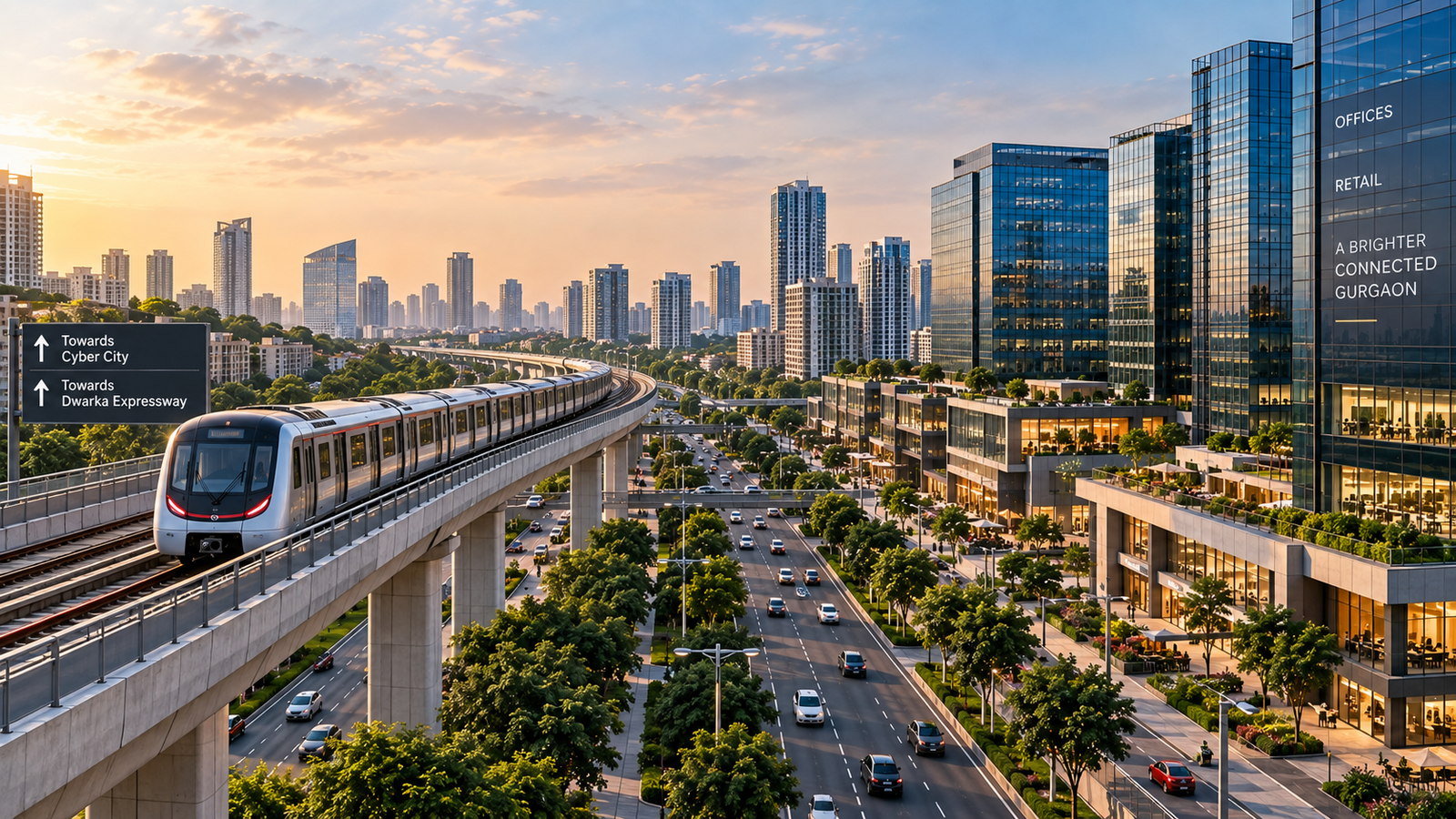
The proposed Gurugram Metro corridor is designed to connect Millennium City Centre with Cyber City, with a spur toward Dwarka Expressway. The approved corridor covers approximately 28.5 km with 27 elevated stations.
More importantly, the planned network is intended to connect older parts of Gurugram with newer residential and commercial areas, Udyog Vihar, Cyber City and the developing areas around Dwarka Expressway.
For commercial real estate, this creates an important question:
Can better public transport connectivity change where businesses want to operate and where customers want to shop?
The answer could be increasingly important for Gurgaon property investors.
1. Why Metro Connectivity Matters for Commercial Property
A commercial property is not valuable simply because of its building.
Its value is also connected to how easily people can reach it.
For an office, accessibility affects employees.
For retail, it affects customers.
For restaurants, it affects footfall.
For healthcare and professional services, it affects convenience.
For investors, it can influence the property's long-term leasing and resale potential.
This makes metro connectivity an important part of commercial real estate planning.
A location close to a well-connected transit network can potentially serve a much larger catchment than a similar property that depends entirely on private vehicles.
2. Gurgaon's Metro Network Is Designed to Connect Old and New Gurgaon
One of the most important characteristics of the proposed Gurugram Metro is its cross-city connectivity.
The planned corridor runs through locations including:
- Millennium City Centre
- Sector 45
- Cyber Park
- Sector 47
- Subhash Chowk
- Sector 48
- Sector 72A
- Hero Honda Chowk
- Udyog Vihar
- Sector 37
- Basai Village
- Palam Vihar
- Sector 22
- Udyog Vihar Phase 4 and 5
- Cyber City
There is also a 1.85-km spur from Basai Village toward Dwarka Expressway.
This alignment is significant because it connects several different types of urban activity:
Residential + Commercial + Industrial + Corporate + Transit
That combination can create stronger economic connections across the city.
3. Office Locations Could Benefit From Better Employee Accessibility
One of the biggest considerations for companies when selecting an office is employee accessibility.
Gurgaon has developed into a major corporate centre, but traffic congestion and long commuting distances remain important considerations for employees.
A stronger metro network could help businesses access a wider workforce without depending entirely on private cars, taxis or buses.
This could be particularly relevant for:
- Technology companies
- Consulting firms
- Financial services
- Startups
- Professional services
- Business process companies
- Shared and flexible offices
For commercial developers, this means that transit-oriented office locations could become increasingly attractive.
4. Metro Stations Can Create New Commercial Catchments
A metro station does more than provide transportation.
It can create a concentrated movement of people.
That movement can support businesses such as:
- Cafés
- Restaurants
- Convenience stores
- Pharmacies
- Fitness centres
- Banks
- Salons
- Clinics
- Co-working spaces
- Small offices
- Service businesses
This is why the area immediately surrounding a transit station can become commercially important.
However, being "near metro" alone does not automatically make a property successful.
The quality of pedestrian access, visibility, surrounding population, parking, road connectivity and permitted commercial use still matter.
5. Retail Could Be One of the Biggest Beneficiaries
Retail depends heavily on accessibility.
Customers generally prefer locations that are easy to reach, easy to identify and convenient to use.
Metro connectivity can potentially increase the catchment of a retail destination by bringing customers from beyond the immediate neighbourhood.
This can support multiple formats.
High-Street Retail
Businesses located along accessible roads near transit nodes can benefit from visibility and convenience.
Food & Beverage
Restaurants and cafés can benefit from a combination of office workers, residents and transit users.
Convenience Retail
Daily-use businesses can potentially benefit from regular commuter movement.
Lifestyle Retail
Fitness, beauty, wellness and entertainment businesses may also benefit from increased accessibility.
The important factor is not simply the number of people passing through a station.
It is whether those people are potential customers for the businesses operating around it.
6. The Metro Could Strengthen Existing Commercial Corridors
Gurgaon's commercial development is not concentrated in one location.
The city has multiple business destinations, including:
- Cyber City
- Udyog Vihar
- Golf Course Road
- Golf Course Extension Road
- Sohna Road
- NH-48
- Dwarka Expressway
- Southern Peripheral Road
- New Gurgaon
The proposed metro network could create stronger connections between several of these urban zones.
Gurugram Metro Rail Limited describes the project as a network intended to connect residential, institutional and commercial areas with industrial areas such as Udyog Vihar and major business districts such as Cyber City.
This could encourage a more interconnected commercial market rather than isolated business clusters.
7. Dwarka Expressway Could Gain Another Connectivity Advantage
Dwarka Expressway has already become one of the major infrastructure-led growth corridors of Gurgaon.
Road connectivity has been a major part of its development story.
The planned metro spur toward the Dwarka Expressway side adds another potential layer of connectivity.
The Gurugram Metro project includes a 1.85-km spur from Basai Village toward Dwarka Expressway, with Sector 101 identified on the route.
For commercial real estate, multiple transportation options can be particularly valuable.
A corridor that combines:
Road + Metro + Residential Growth + Commercial Development
can potentially create a stronger long-term business ecosystem.
8. Transit-Oriented Development Could Become More Important
One of the broader trends to watch is Transit-Oriented Development (TOD).
TOD generally focuses on creating compact, accessible and mixed-use urban environments around public transport.
Gurugram Metro Rail Limited specifically identifies the developing TOD zone along Dwarka Expressway as part of the broader connectivity vision of the metro corridor.
For commercial real estate, TOD can encourage:
- Better pedestrian connectivity
- Higher accessibility
- Mixed-use development
- Retail around transit nodes
- Offices near transportation
- More efficient use of urban land
This could influence how future commercial projects are planned.
9. Connectivity Can Expand the Potential Employee Catchment
Consider two office locations.
Location A
Accessible primarily by private vehicle.
Location B
Accessible by road, metro, bus and other public transportation.
For a business with hundreds of employees, Location B may provide a broader recruitment catchment.
Employees living in different parts of Gurgaon may find the office easier to reach.
That can become a competitive advantage for companies competing for talent.
As office occupiers become more conscious of employee experience, transport connectivity could become part of the office-location decision itself.
10. Hospitality and Food Businesses Could Also Benefit
Commercial ecosystems are becoming increasingly interconnected.
An office district generates employees.
Employees create demand for food, cafés and services.
Corporate offices also generate demand for hotels, meeting spaces and business hospitality.
Improved public transportation can potentially strengthen these connections.
This is particularly relevant in commercial districts that combine:
Offices + Hotels + Restaurants + Retail + Entertainment
The result can be a more active commercial environment throughout the day rather than one that depends entirely on office hours.
11. What Could Happen Around Future Metro Stations?
The most interesting opportunities may not necessarily be directly inside today's established commercial districts.
Future stations can become catalysts for new commercial clusters.
Over time, areas around stations may see increased interest from:
- Retailers
- Restaurants
- Offices
- Co-working operators
- Healthcare providers
- Financial institutions
- Convenience businesses
- Developers
But investors should avoid assuming that every station will automatically become a commercial hotspot.
Station proximity is an advantage—not a guarantee.
The surrounding urban ecosystem remains critical.
12. What Commercial Property Buyers Should Evaluate
If metro connectivity is part of your investment thesis, consider more than distance from the nearest station.
1. Actual Walking Accessibility
A property that is technically 800 metres away but difficult to reach on foot may not benefit as much as expected.
2. Road Connectivity
Metro should complement road access rather than replace it.
3. Catchment Population
Look at existing and planned residential development around the property.
4. Commercial Demand
Determine what businesses are likely to operate successfully in the location.
5. Visibility
For retail, visibility can be particularly important.
6. Parking
Even metro-connected properties may require adequate parking depending on their business model.
7. Project Quality
Building design, maintenance, common areas and facilities can influence tenant and customer experience.
8. Legal Status
Verify title, approvals, land use, RERA registration where applicable and other relevant documentation.
9. Infrastructure Timeline
Always distinguish between:
Proposed → Approved → Under Construction → Operational
An investor should never value a property solely on the assumption that a proposed infrastructure project will be completed exactly as expected.
13. Metro Connectivity Does Not Replace Location Fundamentals
There is a common misconception in real estate:
"The property is near a metro station, so it must be a good investment."
That is too simplistic.
Successful commercial property generally requires a combination of factors.
Connectivity + Catchment + Visibility + Accessibility + Demand + Product Quality + Pricing
Metro connectivity can strengthen the equation, but it cannot fix a fundamentally weak location.
A poorly planned commercial project with weak tenant demand does not automatically become successful simply because a metro station is nearby.
14. Gurgaon Could Move Toward a More Connected Commercial Ecosystem
The long-term significance of Gurgaon's metro expansion may be larger than individual stations.
It could help connect previously separated economic zones.
The official metro plan is specifically intended to integrate Old and New Gurugram and connect residential, institutional, commercial and industrial areas.
That creates the possibility of a more connected city where:
People can live in one part of Gurgaon, work in another, shop somewhere else and still move efficiently between them.
For commercial real estate, this can expand the potential customer and employee catchment of multiple locations.
15. The Future of Commercial Real Estate May Be More Transit-Led
Gurgaon's next generation of commercial development may increasingly focus on accessibility rather than simply creating larger buildings.
The most successful projects could be those that combine:
- Strategic location
- Public transportation
- Road connectivity
- Residential catchment
- Office demand
- Retail activity
- Quality infrastructure
- Walkability
- Customer convenience
This represents a broader shift in commercial real estate.
The question is moving from:
"How large is the project?"
to:
"How well is the project connected to the people who will use it?"
What This Means for Gurgaon Commercial Property Investors
For investors exploring commercial property in Gurgaon, metro connectivity should become one of the factors included in location analysis.
The proposed 28.5-km Gurugram Metro corridor, with 27 elevated stations and a spur toward Dwarka Expressway, has the potential to improve connections between important residential, commercial and employment zones.
But the best opportunities will likely be determined by the combination of transit accessibility, surrounding development, business demand and property fundamentals.
The goal should not be to buy simply because a metro line is planned nearby.
The goal should be to identify a commercial property that can benefit from the larger economic ecosystem created by better connectivity.
BHQ Realty Perspective
At BHQ Realty, we believe that understanding commercial real estate requires looking beyond the property itself.
Infrastructure, connectivity, surrounding development, business demand and future urban growth can all influence the long-term relevance of a commercial location.
Gurgaon's evolving metro network is one of the infrastructure developments worth watching closely as the city's commercial landscape continues to mature.
For investors and businesses evaluating commercial property in Gurgaon, connectivity should be treated as a strategic factor—not just a location feature.
Frequently Asked Questions
Is metro connectivity important for commercial property in Gurgaon?
Yes. Metro connectivity can improve accessibility for employees, customers and visitors, potentially increasing the catchment of a commercial location.
Which Gurgaon areas will be connected by the proposed metro?
The approved corridor connects Millennium City Centre with Cyber City and includes locations such as Sector 45, Sector 47, Sector 48, Sector 72A, Hero Honda Chowk, Udyog Vihar, Basai Village, Palam Vihar and other areas. A spur connects toward Dwarka Expressway.
How long is the Gurugram Metro corridor?
The approved corridor is approximately 28.5 km long with 27 elevated stations, including a 1.85-km spur toward Dwarka Expressway.
Will metro connectivity increase commercial property prices?
Improved connectivity can support demand and accessibility, but price appreciation is not guaranteed. Property fundamentals, supply, demand, development quality and market conditions remain important.
Is buying commercial property near a proposed metro station a good strategy?
It can be worth evaluating, but buyers should not rely on metro proximity alone. They should verify the project's legal status, exact station location, implementation stage, accessibility, surrounding development and potential commercial demand.
Why is metro connectivity important for offices?
It can make offices easier for employees to reach and potentially expand the geographical area from which companies can attract workers.