Over the last few decades, Gurugram has evolved from a peripheral urban centre into one of India's most important corporate, residential and commercial destinations. Its transformation has been closely connected to the growth of roads, expressways, business districts, residential communities and public transportation.
Today, infrastructure and connectivity are once again becoming major forces shaping the future of commercial real estate in Gurgaon.
As new corridors become more accessible and established areas continue to evolve, the relationship between infrastructure and commercial development is becoming increasingly important.
For businesses, better connectivity can mean easier access to employees, customers and clients.
For consumers, it can mean more convenient shopping, dining and everyday services.
For investors, it means looking beyond today's location and understanding how a particular micro-market could evolve as the surrounding infrastructure develops.
For BHQ Realty, which is expanding its development footprint and preparing to enter commercial development in Gurgaon, understanding this relationship is central to creating relevant, future-ready commercial spaces. BHQ Realty describes its focus as private developments and builder floors across Gurgaon and other markets, while also offering commercial property consulting and investor deal structuring.
Infrastructure Is More Than Roads
When people talk about real estate infrastructure, roads are often the first thing that comes to mind.
But infrastructure is much broader.
It includes:
- Highways and expressways
- Internal roads
- Metro connectivity
- Public transportation
- Pedestrian infrastructure
- Parking
- Water supply
- Drainage
- Electricity
- Telecommunications
- Social infrastructure
- Retail and lifestyle amenities
The Gurugram Metropolitan Development Authority (GMDA), for example, identifies mobility management, roads, bridges, pedestrian facilities, public transportation, parking and other urban infrastructure as part of its development responsibilities. Its GIS platform currently maps thousands of kilometres of road and water networks across its planning area.
This matters because a commercial property does not operate independently.
Its success is influenced by the wider ecosystem around it.
A beautifully designed commercial building may struggle if customers cannot reach it conveniently. Conversely, a well-connected location can become increasingly attractive as surrounding residential and business activity grows.
That is why connectivity is one of the fundamental considerations in commercial real estate in Gurgaon.
Why Connectivity Matters for Commercial Real Estate
· A commercial property serves multiple groups of people.
· Employees need to reach their workplace.
· Customers need to visit businesses.
· Suppliers need access for deliveries.
· Business owners need convenient connections to other parts of the city.
· Investors need confidence that the location can remain commercially relevant.
· Connectivity affects all of these factors.
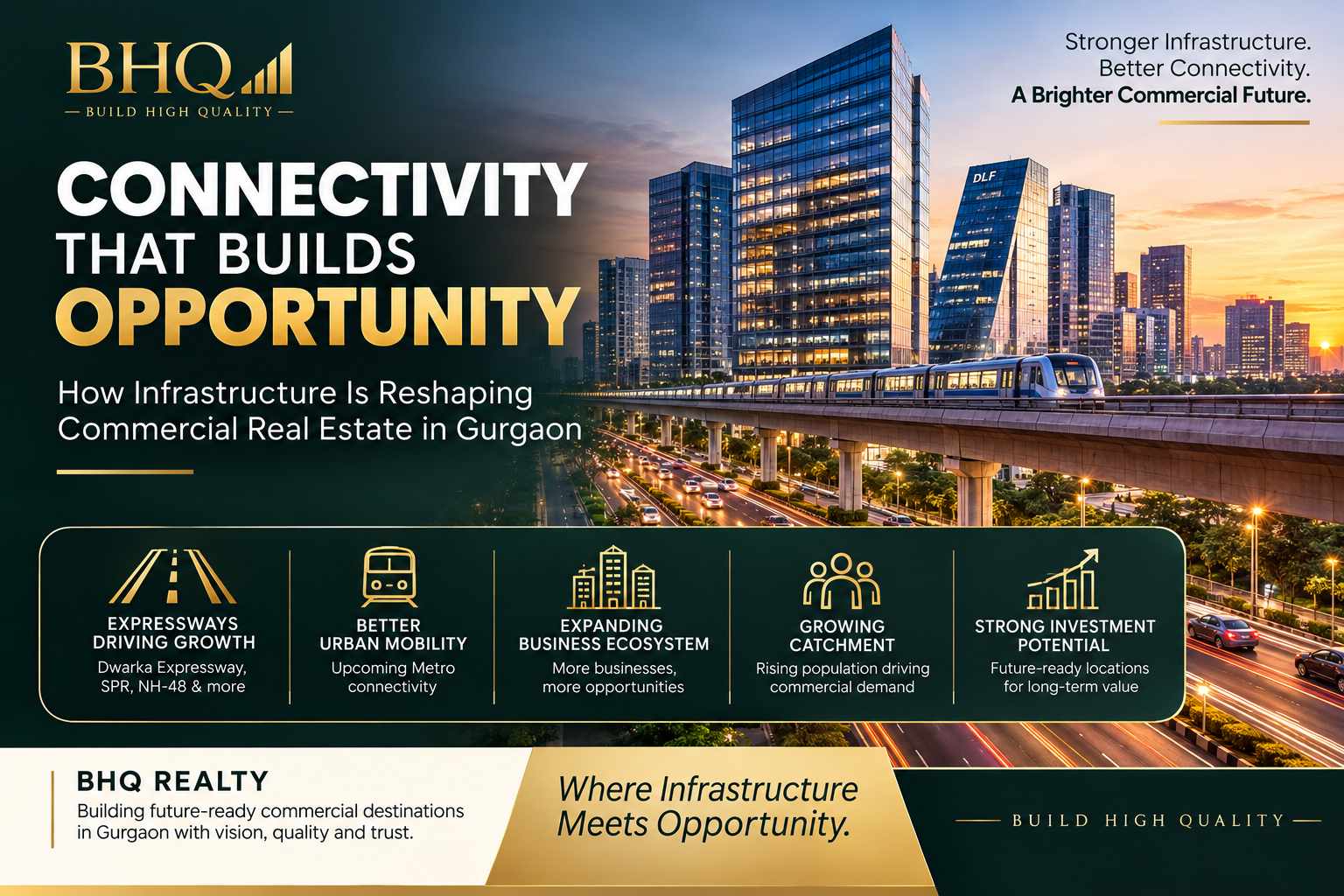
Better connectivity can contribute to:
Accessibility
Customers and employees can reach the property more conveniently.
Catchment expansion
Businesses can potentially attract customers from a wider surrounding area.
Business convenience
Better road and transport connections can make daily operations easier.
Location visibility
Strategically positioned commercial destinations can benefit from stronger movement and accessibility.
Long-term relevance
Infrastructure improvements can change the importance of previously emerging locations.
However, infrastructure should never be treated as a guarantee of investment returns. Actual commercial performance depends on multiple factors, including demand, supply, project quality, execution, pricing and the broader economic environment.
That distinction is important for anyone evaluating commercial property in Gurgaon.
Dwarka Expressway: A New Dimension of Connectivity
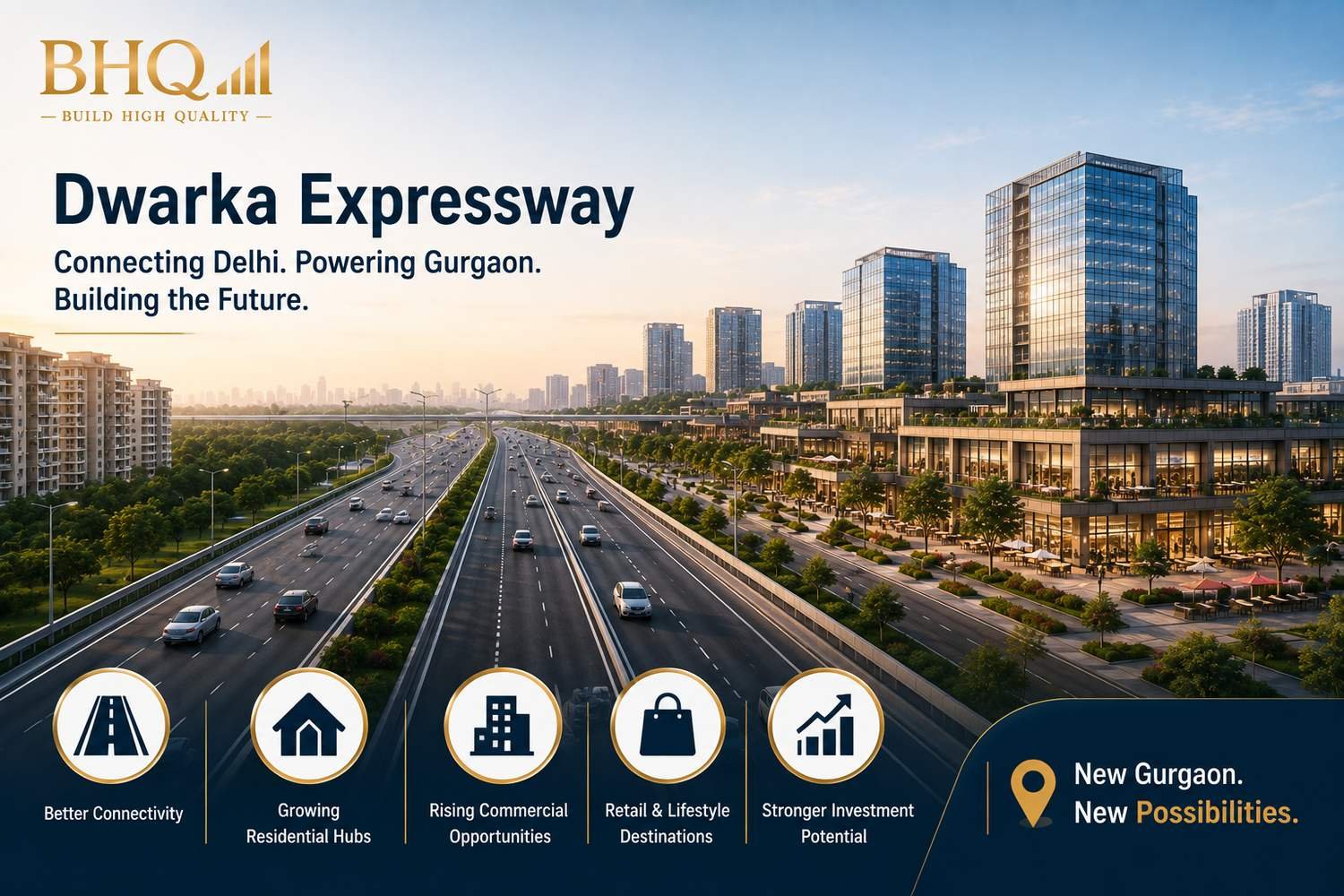
Few infrastructure developments have attracted as much attention in the Gurgaon real estate story as the Dwarka Expressway.
The Haryana section of the eight-lane Dwarka Expressway was inaugurated in March 2024. The Ministry of Road Transport & Highways described the Haryana section as 19 km long and developed at a cost of approximately ₹4,100 crore.
The expressway has strengthened connections between Delhi and Gurugram and has contributed to the development of new residential and commercial catchments along the corridor.
For commercial real estate, the significance is not simply the road itself.
Infrastructure changes how people move.
And when movement patterns change, business locations can change with them.
Areas that were previously considered peripheral can become more accessible. New residential communities can emerge. Retail and service businesses can follow population growth. Offices and mixed-use developments can increasingly look toward these new corridors.
This is one reason infrastructure deserves to be considered as part of a commercial property's broader location strategy.
Southern Peripheral Road: From Connector to Growth Corridor
Southern Peripheral Road, commonly known as SPR, provides another example of how connectivity can influence Gurgaon's real estate landscape.
SPR connects important parts of the city and links areas around Golf Course Extension Road, Sohna Road and NH-48.
The corridor is also seeing continued infrastructure attention.
In March 2026, GMDA floated a ₹755 crore tender for a 4.2-km elevated corridor between Vatika Chowk and NH-48. According to the authority, the proposed signal-free corridor is intended to strengthen connectivity between SPR, Dwarka Expressway, NH-48 and the Gurugram-Sohna Elevated Corridor.
That is significant because infrastructure corridors increasingly function as more than transportation routes.
They can become development corridors.
As accessibility improves and surrounding residential and commercial projects expand, the economic activity around these corridors can become more diversified.
Recent reporting has also highlighted SPR's transition from a connector road toward a broader emerging urban and real estate ecosystem.
For investors and businesses, this reinforces an important principle:
A location should be evaluated not only by what exists today, but also by the infrastructure and development ecosystem forming around it.
The Role of Metro Connectivity
Road infrastructure is only one part of the story.
Public transportation can also influence how commercial destinations function.
The proposed Gurugram Metro corridor is designed to connect old and new Gurugram, with the planned 28.5-km corridor connecting residential, institutional and commercial areas with employment centres including Udyog Vihar and Cyber City. The Gurugram Metro Rail Limited (GMRL) also describes a 1.85-km spur toward Dwarka Expressway and proposed interchanges with existing and planned transport systems.
For commercial development, mass transit can be particularly relevant.
Why?
Because businesses depend heavily on people.
A commercial destination that can be conveniently accessed by road and public transportation can potentially serve a broader workforce and customer base.
This is especially relevant as Gurgaon becomes increasingly dense and urban mobility becomes a bigger consideration for businesses and employees.
Residential Growth Creates Commercial Demand
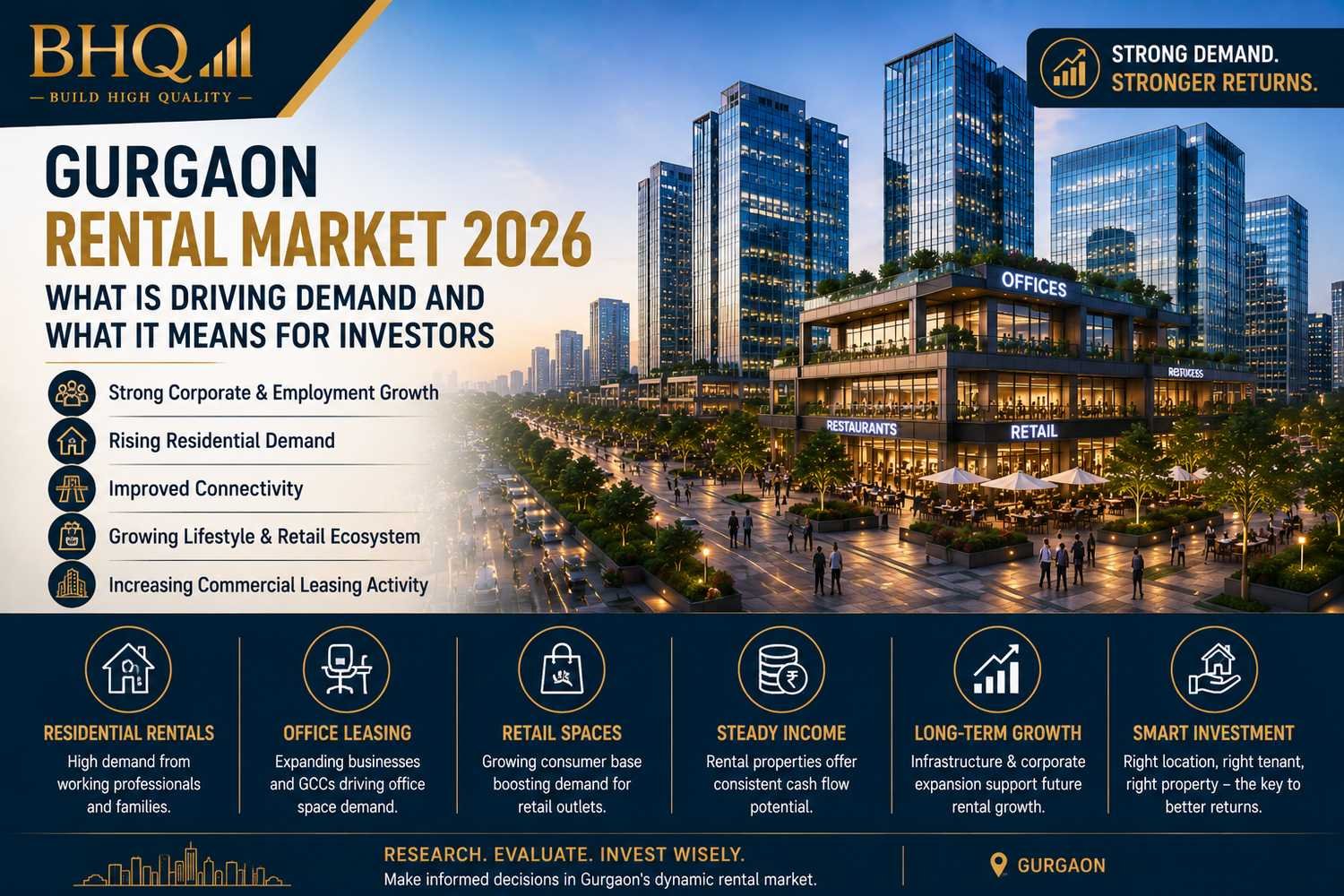
One of the most important relationships in Gurgaon real estate is the connection between residential development and commercial activity.
When thousands of people move into a new residential catchment, their daily requirements follow.
They need:
- Grocery stores
- Restaurants
- Cafés
- Pharmacies
- Clinics
- Salons
- Fitness centres
- Banks
- Professional services
- Convenience retail
- Entertainment
This creates an ecosystem of local commercial demand.
In other words:
Residential growth creates people.
People create consumption.
Consumption creates commercial demand.
This is why commercial developers need to understand not just the property itself, but also the population and development surrounding it.
A commercial project located within or near a growing residential catchment may serve a very different purpose from a corporate office destination.
Understanding that distinction is essential.
Gurgaon Is Becoming a Network of Commercial Micro-Markets
Another important change is that Gurgaon is no longer defined by a single commercial centre.
Instead, the city is developing multiple interconnected micro-markets.
Established destinations coexist with emerging corridors.
Different areas cater to different requirements:
- Corporate offices
- High-street retail
- Food and beverage
- Premium workplaces
- Local neighbourhood retail
- Mixed-use developments
- Hospitality
- Professional services
This decentralisation is partly enabled by infrastructure.
As connectivity improves, businesses do not necessarily need to concentrate around one traditional business district.
New commercial destinations can emerge closer to growing residential populations and new employment clusters.
For investors, this creates both opportunity and complexity.
The challenge becomes identifying which locations have genuine underlying demand rather than simply following the latest market narrative.
Connectivity and the Modern Customer Experience
This brings us back to an important idea from our previous BHQ Realty article: human-centric commercial design.
Connectivity should not stop at the property boundary.
A truly thoughtful commercial development considers the entire customer journey.
Imagine arriving at a commercial destination.
Can you find the entrance easily?
Is parking convenient?
Is pedestrian movement safe?
Can you quickly identify the business you are visiting?
Are the common areas comfortable?
Can you move between retail, dining and other facilities without unnecessary friction?
These details influence how people experience a property.
Therefore, the future of commercial real estate in Gurgaon is likely to be shaped by the combination of:
Connectivity + Accessibility + Design + Experience
A strategic location may bring people to a destination.
Good design can give them a reason to stay.
What Infrastructure Means for Businesses
For businesses considering commercial property in Gurgaon, infrastructure can influence several practical decisions.
Employee Accessibility
Businesses compete for talent.
A location that is difficult for employees to reach can create an everyday operational challenge.
Better connectivity can expand the pool of people who can conveniently commute to the workplace.
Customer Accessibility
For retail, hospitality and customer-facing businesses, accessibility is even more important.
Customers are more likely to value destinations that are easy to find and reach.
Logistics
Businesses also need deliveries, service providers and operational support.
Road connectivity can therefore affect more than customer footfall.
Business Networking
Gurgaon's commercial ecosystem brings together companies across technology, finance, consulting, professional services and other sectors.
Connectivity between business districts can facilitate interaction across this ecosystem.
What Infrastructure Means for Investors
For investors evaluating commercial real estate investment in Gurgaon, infrastructure should be part of a wider due-diligence process.
Instead of simply asking:
"Is there a new road coming?"
ask:
1. What does the infrastructure actually connect?
A road is more meaningful when it connects important residential, employment or commercial nodes.
2. What is the current level of development?
An infrastructure announcement is not the same as an operational infrastructure project.
3. What is developing around it?
Look at residential projects, offices, retail, schools, hospitals and other supporting infrastructure.
4. Is there genuine demand?
Infrastructure alone does not create a successful commercial market.
There needs to be people and businesses to support it.
5. What is the project quality?
A strong location cannot compensate for poor planning, weak execution or unsuitable commercial formats.
6. What is the competitive landscape?
Investors should understand how many competing commercial projects exist or are planned within the same catchment.
Infrastructure-Led Growth Does Not Mean Every Location Will Perform Equally
It is important to avoid a common misconception:
Better infrastructure does not automatically mean guaranteed appreciation or commercial success.
Real estate is location-specific.
Two properties may be only a few kilometres apart but have completely different commercial characteristics.
One may have better frontage.
Another may have stronger footfall.
One may have established businesses nearby.
Another may still be waiting for surrounding development.
One may have excellent access.
Another may face local traffic, drainage or parking constraints.
Even within rapidly developing Gurgaon, infrastructure gaps remain in some locations. For example, recent reporting has highlighted recurring waterlogging concerns around the Sector 102/102A road near Dwarka Expressway, illustrating why investors should evaluate infrastructure at the micro-market and project level, not rely only on broad corridor narratives.
This is where informed due diligence becomes essential.
The Importance of Looking Beyond the Brochure
A commercial property purchase is a significant decision.
Investors should therefore go beyond marketing material.
Study:
- Exact location
- Approach roads
- Existing infrastructure
- Proposed infrastructure
- Surrounding development
- Catchment population
- Competing projects
- Parking arrangements
- Project approvals
- Developer track record
- Commercial format
- Demand from actual businesses
- Pricing relative to comparable properties
A site visit can also reveal details that a brochure cannot.
This is one of the areas where local market knowledge becomes valuable.
BHQ Realty highlights its Gurgaon market understanding, property shortlisting, site-visit support, transparent guidance and negotiation assistance as part of its buyer-focused approach.
What This Means for the Future of Commercial Projects in Gurgaon
The next generation of commercial projects in Gurgaon will likely be shaped by a combination of infrastructure and changing user expectations.
Commercial developments will increasingly need to think about:
· Accessibility: Can people reach the property conveniently?
· Flexibility: an businesses adapt their spaces as their needs change?
· Experience: Does the destination provide a comfortable environment for customers and employees?
· Integration: Does the project connect naturally with its surrounding neighbourhood?
· Sustainability: Can infrastructure and design support efficient, responsible long-term development?
· Convenience: Can people complete their daily activities without unnecessary friction?
These factors are becoming increasingly relevant as Gurgaon matures from a fast-growing city into a more complex urban ecosystem.
BHQ Realty and Gurgaon's Next Commercial Chapter
BHQ Realty's journey reflects the broader evolution from real estate advisory and market expertise toward project-led development.
The company says its journey began with real estate consulting, followed by expansion into construction and development and the establishment of BHQ Realty in 2025. Its current offering includes private real estate developments, builder floors, commercial property consulting and investor deal structuring.
Its first commercial project in Gurgaon therefore arrives at an interesting point in the city's development.
The opportunity is not simply to build another commercial property.
It is to understand where people are moving, where businesses are expanding, how infrastructure is evolving and what modern users expect from commercial destinations.
That understanding can help shape commercial spaces that are relevant not only at launch, but for years to come.
The Future of Gurgaon Will Be Built Around Connectivity
Gurgaon's evolution demonstrates a simple principle:
Infrastructure changes accessibility.
Accessibility changes movement.
Movement influences development.
And development creates new commercial ecosystems.
From Dwarka Expressway to SPR and the proposed metro network, Gurgaon's infrastructure landscape continues to evolve. Official planning and infrastructure agencies are also increasingly using integrated mobility, GIS and urban-planning systems to manage the city's growth.
But infrastructure alone is not enough.
The most successful commercial destinations will need to combine connectivity with thoughtful planning, strong execution, good design and genuine market demand.
That is where the future of commercial real estate in Gurgaon becomes particularly interesting.
The question is no longer simply:
"Where is the next commercial project?"
It is:
"Where is the next commercial ecosystem being created?"
For businesses, investors and developers, understanding that difference can make all the difference.
And as Gurgaon continues to grow, the commercial destinations that successfully connect people, businesses, infrastructure and experience may become the places that define the city's next chapter.
BHQ Realty Building High Quality, with a vision for the commercial future of Gurgaon.
Frequently Asked Questions
Why is connectivity important for commercial real estate in Gurgaon?
Connectivity influences how easily employees, customers, businesses and service providers can reach a commercial property. Roads, expressways and public transportation can therefore play an important role in determining a property's accessibility and broader market relevance.
Which infrastructure projects are influencing Gurgaon real estate?
Major corridors and infrastructure initiatives include Dwarka Expressway, Southern Peripheral Road improvements and the proposed Gurugram Metro network. Their relevance varies by location and should be evaluated at the micro-market level.
Does better infrastructure guarantee higher property returns?
No. Infrastructure can improve accessibility and support development, but it does not guarantee appreciation or rental returns. Investors should evaluate demand, supply, pricing, project quality, execution and local infrastructure before making a decision.
What should I check before investing in commercial property in Gurgaon?
Consider the property's exact location, connectivity, surrounding development, catchment, competition, project approvals, developer credentials, commercial format, pricing and long-term demand.
Why is Gurgaon important for commercial real estate?
Gurgaon has a large corporate ecosystem, established business districts, expanding residential communities and significant infrastructure development, creating a diverse environment for offices, retail, hospitality and other commercial uses.
How is BHQ Realty approaching commercial development?
BHQ Realty describes itself as a real estate developer with a growing footprint across Gurgaon and other markets. Its current capabilities include private developments, builder floors, commercial property consulting and investor deal structuring.