Gurgaon's commercial real estate market is entering a new phase.
The city has already established itself as one of India's most important corporate destinations, but the latest market data suggests that the next stage of growth is being driven by a changing mix of occupiers.
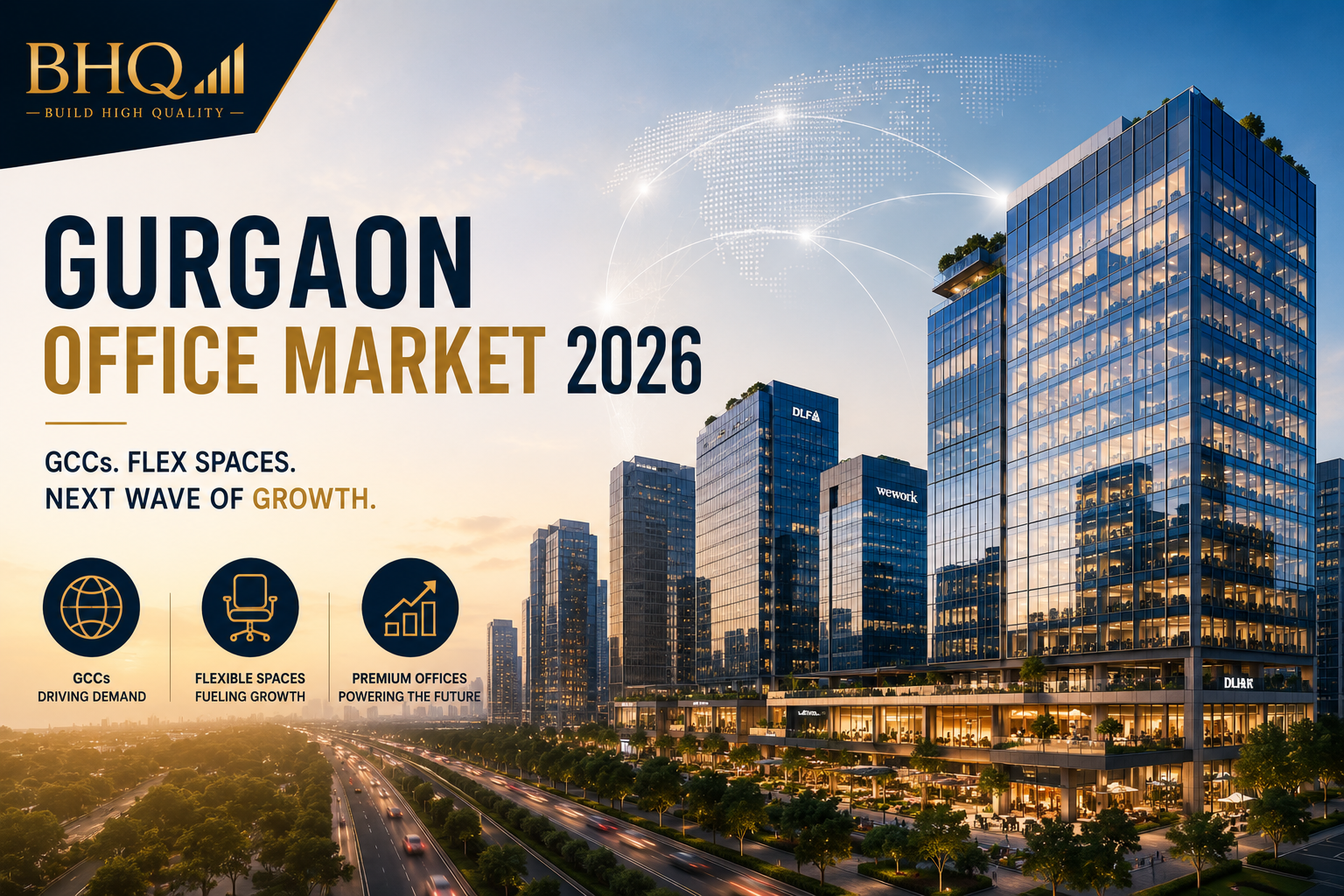
Global Capability Centres (GCCs), technology companies, BFSI firms and flexible workspace operators are increasingly shaping office demand.
This is more than a short-term leasing trend.
It reflects a broader transformation in how global companies view Indian cities, how businesses use office space and what they expect from commercial developments.
According to CBRE, India's office market recorded 45.5 million sq. ft. of absorption in H1 2026, the highest ever for a half-year period. GCCs accounted for 43% of that leasing, while flexible workspace operators were also among the leading demand drivers.
Gurgaon is particularly well positioned within this national story.
Recent market analysis from Cushman & Wakefield shows that Gurugram remained the dominant office market within Delhi-NCR, while GCC demand continued to be supported by multinational occupiers and strong business infrastructure.
For BHQ Realty, which is preparing to bring its first commercial project to Gurgaon, these developments provide an important insight into what the next generation of commercial spaces may need to offer.
The Big Shift in Gurgaon's Office Market
The traditional office model was relatively straightforward.
A company leased space.
Employees came to work.
The office was designed around desks, cabins, meeting rooms and basic amenities.
That model is changing.
Today, companies are looking for workplaces that can support:
- Collaboration
- Technology
- Flexibility
- Employee experience
- Business growth
- Sustainability
- Accessibility
- Brand identity
At the same time, companies are becoming more strategic about how much permanent space they need.
This has created a growing role for GCCs and flexible workspace providers.
What Are GCCs and Why Do They Matter?
Global Capability Centres are dedicated operations established by multinational companies to perform functions such as technology, research, finance, analytics, engineering, cybersecurity and other specialised activities.
India has become one of the world's major GCC destinations.
And Gurgaon is an important part of that ecosystem.
The latest national office-market data shows just how significant GCC demand has become.
CBRE reported that GCCs accounted for 42% of India's office take-up in Q2 2026, while their leasing reached approximately 10.3 million sq. ft. during the quarter.
JLL's Q1 2026 research similarly showed GCCs accounting for 45.5% of India's gross office leasing, with technology and BFSI among the major sectors driving GCC activity.
This matters for Gurgaon because GCCs require sophisticated office environments.
They often need:
- Large floor plates
- High-quality infrastructure
- Reliable connectivity
- Advanced technology
- Security
- Flexible layouts
- Employee amenities
- Access to skilled talent
That can create demand for higher-quality commercial assets.
Gurgaon Is Well Positioned for Global Businesses
Gurgaon's corporate ecosystem has developed over decades.
The city is home to multinational corporations, financial institutions, technology companies, consulting firms, professional services businesses and startups.
This creates an environment where global companies can access:
Talent + Infrastructure + Business Ecosystem + Connectivity
Recent developments reinforce Gurgaon's continuing role in the GCC landscape. For example, Primus Partners recently opened a Global Capability Hub in Gurugram as part of its expansion beyond Bengaluru, highlighting the city's role as a strategic location for global business operations.
The importance of this trend extends beyond the companies establishing GCCs.
Every new corporate operation creates additional demand across the surrounding ecosystem.
Employees need housing.
Businesses need restaurants.
Teams need hotels.
Professionals need cafés and services.
This creates a multiplier effect across the local real estate market.
Flexible Workspaces Are Another Major Growth Driver
The second major trend is the rise of flexible workspaces.
Flexible workspace operators allow businesses to access offices without necessarily committing to conventional long-term arrangements for their entire footprint.
This can include:
- Coworking
- Managed offices
- Serviced offices
- Enterprise flex spaces
- Meeting spaces
- Hybrid workplace solutions
The growth has been particularly visible in Delhi-NCR.
CBRE reported that flexible workspace operators accounted for 45% of Delhi-NCR's approximately 3.6 million sq. ft. of office leasing in Q2 2026, with around 1.6 million sq. ft. leased by flex operators.
That is a significant shift.
It suggests that flexibility is becoming an increasingly important component of corporate real estate strategy.
Why Businesses Want Flexible Offices
Businesses today operate in a less predictable environment.
A startup may double its workforce.
A multinational may establish a new team.
A company may enter a new market.
Another may reduce its permanent footprint.
Flexible workspace allows businesses to adjust more easily.
This is why the core + flex approach is becoming increasingly relevant.
A company may maintain a permanent headquarters while using flexible space for:
- Project teams
- Expansion
- Temporary workforce
- Satellite offices
- New-city entry
- Overflow requirements
For commercial developers, this means flexibility can become an important part of building design.
What Does This Mean for Commercial Development?
The changing occupier profile is influencing what businesses expect from commercial buildings.
A modern office project may need to provide more than efficient floor plates.
It may need to offer:
Better connectivity
Employees and clients need convenient access.
Strong digital infrastructure
Modern businesses depend heavily on technology.
Flexible layouts
Companies may change their requirements over time.
High-quality common areas
Shared spaces increasingly influence workplace experience.
Food and beverage
Cafés and restaurants can support employees and visitors.
Wellness
Businesses increasingly recognise the importance of employee well-being.
Sustainability
Energy efficiency and environmental performance are becoming more important.
Security
Corporate occupiers may have sophisticated security requirements.
The result is a shift from office building to workplace ecosystem.
Grade-A Quality Is Becoming More Important
Gurgaon's office market has already crossed a major milestone, with office stock exceeding 100 million sq. ft. in 2026, according to CBRE data reported by multiple outlets.
When a market reaches this scale, competition increases.
Businesses have more options.
Investors have more choices.
Developers need stronger differentiation.
This makes Grade-A quality, sustainability, location and user experience increasingly important.
The question is no longer:
"Is there office space available?"
It is:
"Is this the right office environment for our business?"
The Human-Centric Workplace
This trend connects directly with the first BHQ Realty article in our content series.
The future of commercial development is becoming increasingly human-centric.
Employees spend a significant part of their day inside workplaces.
Their experience can influence productivity, collaboration, engagement and even how they perceive their employer.
This is why modern commercial spaces increasingly incorporate:
- Natural light
- Landscaped areas
- Comfortable lounges
- Informal meeting areas
- Cafés
- Breakout spaces
- Wellness facilities
- Walkable environments
A workplace should support both business performance and human experience.
Why Connectivity Remains Critical
GCCs and large businesses are particularly sensitive to accessibility.
Companies need their employees to reach the workplace reliably.
Clients need convenient access.
Business partners need connectivity.
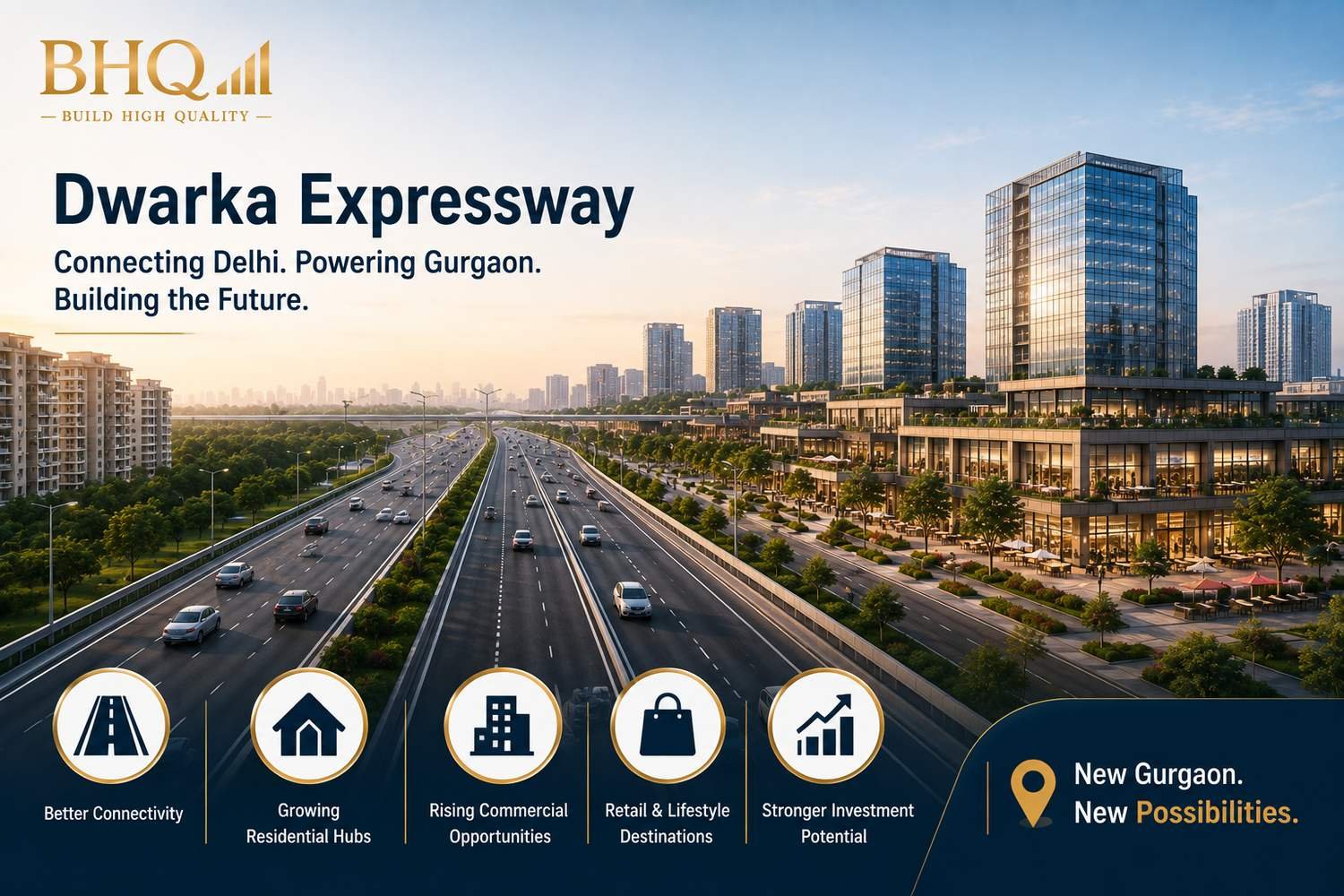
This makes Gurgaon's infrastructure story particularly relevant.
Major corridors such as:
- Dwarka Expressway
- NH-48
- Southern Peripheral Road
- Golf Course Road
- Golf Course Extension Road
- Sohna Road
continue to influence the city's commercial geography.
But infrastructure should be evaluated at the micro-market level.
A major road alone does not guarantee commercial success.
The surrounding population, businesses, accessibility, supply and project quality all matter.
Retail Benefits From Office Growth Too
One of the less obvious consequences of office growth is its impact on retail.
A large office population creates daily demand.
Employees need:
Coffee → Lunch → Groceries → Fitness → Healthcare → Personal Services → Entertainment
This creates opportunities for nearby retail and F&B businesses.
A commercial development that combines office and retail can therefore create a more complete ecosystem.
This is one reason mixed-use commercial environments are becoming increasingly relevant in Gurgaon.
What Does This Mean for Commercial Property Investors?
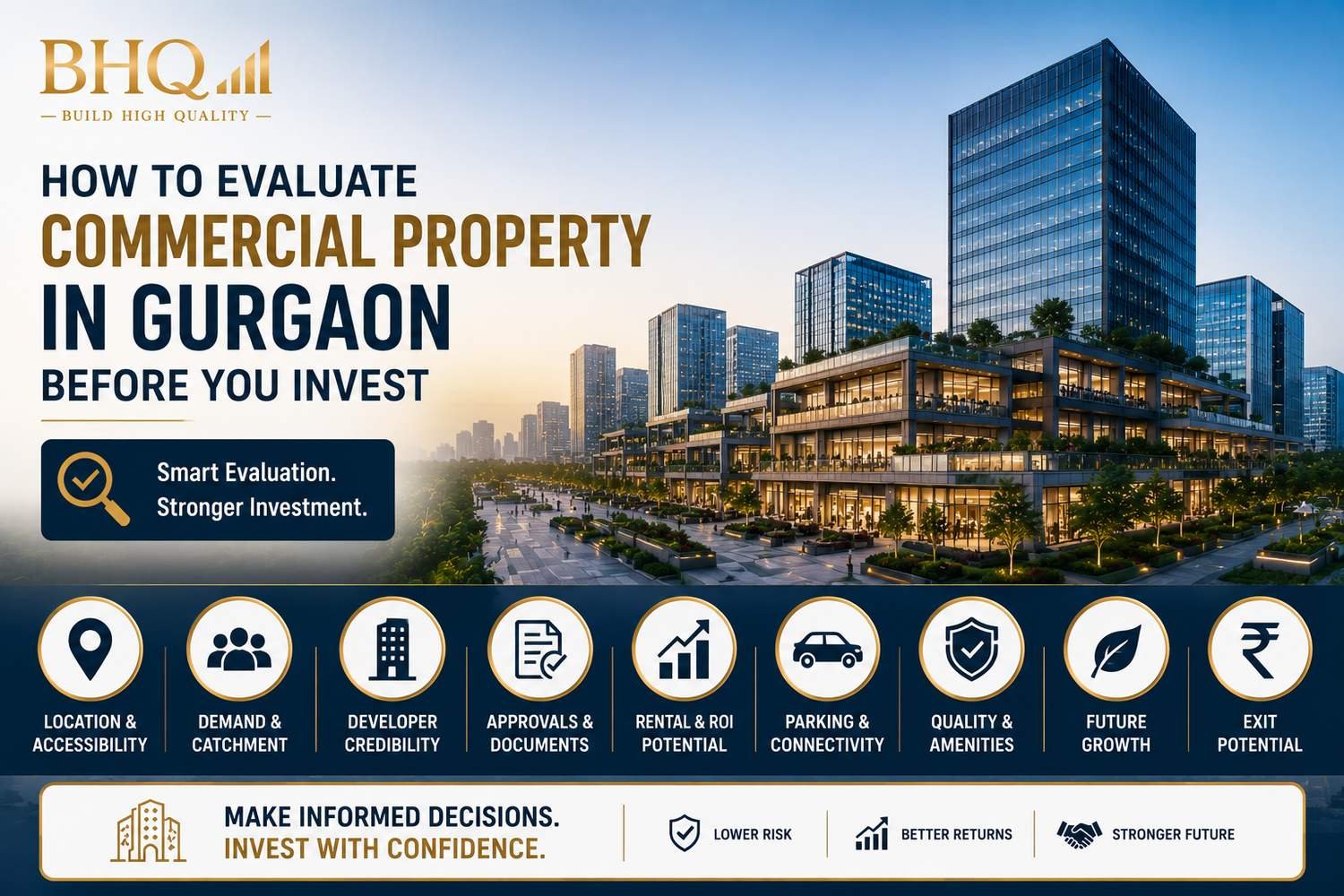
For investors considering commercial property in Gurgaon, the changing office market creates several areas worth watching.
1. Occupier Quality
Who is likely to occupy the property?
A location that attracts established businesses may have different commercial characteristics from one dependent on small local occupiers.
2. Flexibility
Can the space accommodate changing tenant requirements?
3. Location
Is the property connected to major business corridors?
4. Infrastructure
What infrastructure exists today, and what is actually under development?
5. Supporting Ecosystem
Are there residential communities, retail, hospitality and services nearby?
6. Competition
How much similar commercial inventory exists?
7. Developer Credibility
Can the developer execute the project to the promised standard?
8. Financial Viability
What are the acquisition, maintenance, vacancy and financing costs?
Investors should assess these fundamentals rather than relying solely on projected rental yields or appreciation.
Why This Matters for BHQ Realty
BHQ Realty is entering the commercial development segment at a time when Gurgaon's commercial market is becoming more sophisticated.
The company's current business includes private real estate developments, builder floors, commercial property consulting and investor deal structuring, with Gurgaon forming a key part of its market positioning. BHQ Realty
Its first commercial project in Gurgaon therefore comes at an important moment.
The opportunity is not simply to create commercial units.
It is to understand the changing requirements of:
- Global businesses.
- Growing companies.
- Flexible workspace operators.
- Employees.
- Customers.
- Investors.
That understanding can help shape commercial environments designed for the next phase of Gurgaon's growth.
What Could Define Gurgaon's Next Office Cycle?
Based on current market trends, several themes are likely to remain important.
GCC expansion
Global companies continue to use India for technology, analytics, finance, R&D and other high-value functions.
Flexible workplaces
Flex operators are becoming an increasingly important part of office leasing, particularly in major markets such as Delhi-NCR.
Premium assets
Businesses are increasingly selective about workplace quality, infrastructure and amenities.
Sustainability
Green-certified and efficient buildings are becoming more relevant to corporate occupiers.
Connectivity
Infrastructure will continue influencing where companies choose to locate.
Experience
The office is increasingly becoming an environment rather than simply a workspace.
The Bigger Picture: Gurgaon Is Becoming a Global Business Destination
Gurgaon's transformation is no longer only about being Delhi's corporate neighbour.
The city has developed its own identity as a global business destination.
Its office ecosystem supports multinational companies, domestic enterprises, startups, professional services and flexible workspace providers.
The next stage of this evolution will likely focus increasingly on quality and sophistication.
Companies will want better workplaces.
Employees will expect better experiences.
Investors will become more selective.
Developers will need to deliver greater value.
And commercial destinations will need to integrate work, lifestyle and convenience.
Conclusion
The latest Gurgaon office-market trends show that the city's commercial story is changing.
GCCs are driving significant office demand.
Flexible workspace operators are expanding.
Technology and BFSI continue to be important occupier segments.
Businesses are seeking better-quality environments.
And commercial development is increasingly moving toward flexible, sustainable and human-centric spaces.
For investors, this means looking beyond simple location-based narratives.
For businesses, it means choosing workplaces that support the way they operate today and tomorrow.
For developers, it means creating commercial spaces that can adapt to changing expectations.
And for BHQ Realty, its first commercial project in Gurgaon represents an opportunity to participate in this next chapter.
Gurgaon's commercial future isn't just about more offices.
It is about better workplaces, stronger business ecosystems and smarter commercial destinations.
Frequently Asked Questions
Why are GCCs important for Gurgaon's real estate market?
GCCs create demand for high-quality office space and can also support surrounding residential, retail, hospitality and service ecosystems.
What is driving Gurgaon office demand in 2026?
GCC expansion, flexible workspace operators, technology companies, BFSI firms and continued corporate activity are among the key demand drivers.
Are flexible workspaces growing in Gurgaon?
Flexible workspace demand has become an important part of Delhi-NCR's office market. CBRE reported that flex operators accounted for 45% of Delhi-NCR office leasing in Q2 2026.
What should businesses consider when choosing office space in Gurgaon?
Businesses should evaluate connectivity, location, building quality, technology infrastructure, flexibility, amenities, employee accessibility, sustainability and total occupancy costs.
What should investors look for in Gurgaon commercial property?
Investors should consider location, occupier demand, supply, connectivity, project quality, developer credibility, operating costs and long-term commercial relevance.
What is BHQ Realty's commercial development focus?
BHQ Realty is expanding its development portfolio in Gurgaon and is preparing to introduce its first commercial project in the city. Its current services also include commercial property consulting and investor deal structuring.