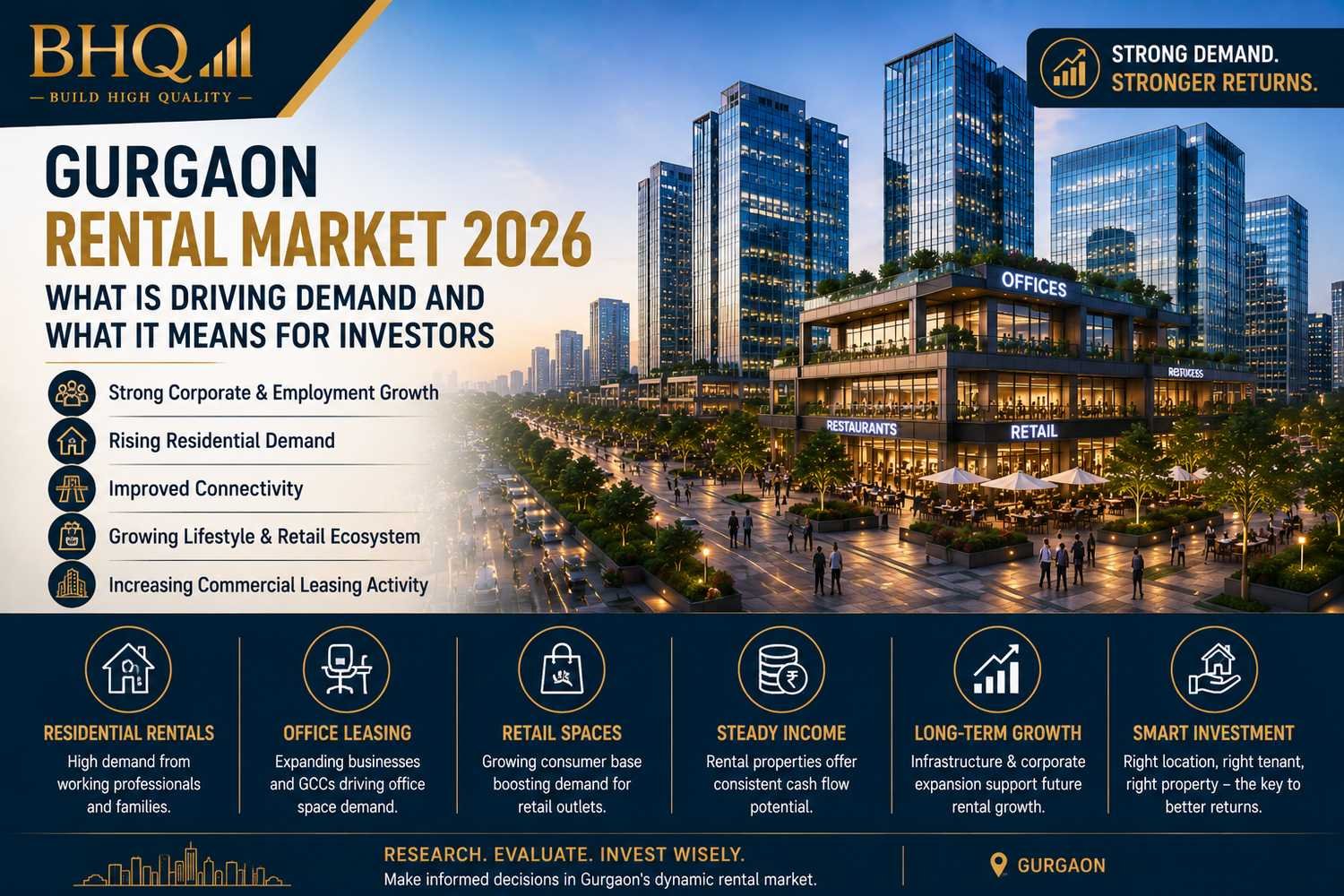
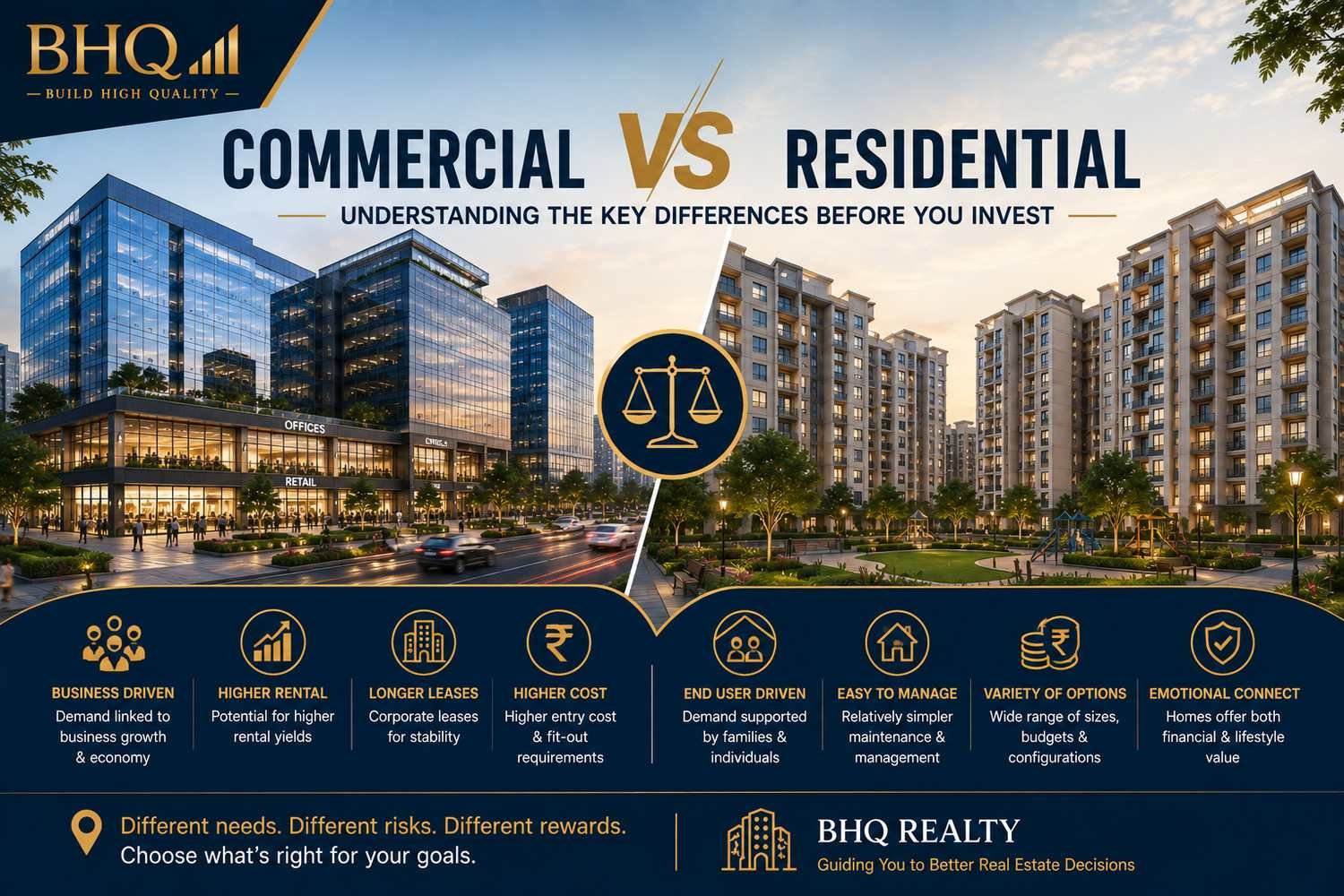
Gurgaon's real estate market offers opportunities across both residential and commercial properties.
From apartments and builder floors to offices, retail spaces and mixed-use developments, buyers today have multiple ways to participate in the city's growing property ecosystem.
But residential and commercial real estate work very differently.
A home is primarily purchased to live in.
A commercial property is generally purchased to support a business, generate rental income, operate a business or participate in the broader commercial property market.
This difference affects almost everything:
- Location
- Demand
- Pricing
- Tenant profiles
- Maintenance
- Rental dynamics
- Vacancy
- Usage
- Investment strategy
So, if you're considering real estate investment in Gurgaon, should you choose residential or commercial property?
The answer depends on your objectives, budget, risk tolerance and understanding of the specific property.
Let's examine the major differences.
Residential and Commercial Property Serve Different Purposes
The most fundamental difference is purpose.
Residential property
Residential real estate is designed primarily for living.
Examples include:
- Apartments
- Builder floors
- Villas
- Independent homes
- Plotted residential developments
The end user is usually an individual, family or household.
Commercial property
Commercial real estate is designed primarily for business activity.
Examples include:
- Office spaces
- Retail shops
- Showrooms
- Restaurants
- Commercial floors
- Business centres
- Mixed-use commercial spaces
The end user may be:
- A company
- Retailer
- Restaurant
- Professional
- Entrepreneur
- Service provider
This difference creates very different demand patterns.
Location Means Something Different for Each
Location is important for both residential and commercial property—but the definition of a good location can be different.
Residential buyers may prioritise:
- Schools
- Hospitals
- Safety
- Neighbourhood environment
- Daily convenience
- Parks
- Community amenities
- Connectivity to workplaces
Commercial buyers may prioritise:
- Customer catchment
- Employee accessibility
- Business ecosystem
- Visibility
- Footfall
- Parking
- Road connectivity
- Nearby offices
- Nearby residential communities
For example, a quiet residential neighbourhood may be excellent for a family home but unsuitable for a customer-facing retail business.
Similarly, a busy commercial corridor may be ideal for a restaurant or office but less attractive to someone seeking a quiet residential environment.
Commercial Property Often Depends More on Business Demand
Residential demand is fundamentally connected to the need for housing.
Commercial demand is connected to economic activity.
A commercial property needs businesses.
Those businesses need customers, employees or clients.
This makes commercial real estate particularly sensitive to the surrounding economic ecosystem.
Consider an office property.
Its commercial relevance can be influenced by:
- Companies expanding nearby
- Employee availability
- Connectivity
- Business districts
- Infrastructure
- Supporting services
A retail property may depend on:
- Residents
- Office workers
- Customer movement
- Visibility
- Spending patterns
Therefore, commercial real estate requires a deeper understanding of who generates demand.
Rental Dynamics Can Be Different
Rental income is one reason people consider both residential and commercial property.
However, the rental dynamics can differ significantly.
Residential tenants are usually households.
Commercial tenants are businesses.
A business may sign a lease based on:
- Location
- Business visibility
- Customer demand
- Office requirements
- Brand positioning
- Operational suitability
The rent itself is only one part of the equation.
Investors should also consider:
- Vacancy
- Maintenance
- Fit-out
- Property management
- Taxes
- Lease terms
- Tenant quality
- Market conditions
This is why advertised rental figures should never be viewed in isolation.
Vacancy Can Work Differently
Vacancy is an important consideration for any rental property.
With residential property, the tenant pool is usually broad because people need housing.
With commercial property, the suitability of a particular space can be much more specific.
A retail unit designed for a particular business format may not work equally well for every business.
Similarly, an office with a particular size, layout or location may appeal to a narrower tenant segment.
This means commercial investors should ask:
Who is the likely tenant for this particular property?
The more clearly that question can be answered, the better the investor can understand the property's commercial positioning.
Commercial Property Requires Understanding the Business Model
This is one of the biggest differences between the two asset classes.
Residential buyers generally don't need to understand the economics of the tenant's business.
Commercial investors should.
Imagine a retail property occupied by a restaurant.
The restaurant's ability to pay rent depends partly on its business performance.
The business needs:
- Customers
- Visibility
- Appropriate rent
- Parking
- Operational access
- Suitable surroundings
Similarly, an office tenant needs the location to work for its employees and clients.
This creates a relationship between property performance and business suitability.
Fit-Out and Operating Costs Matter
Commercial properties often require significant fit-out depending on their intended use.
An office may require:
- Workstations
- Meeting rooms
- IT infrastructure
- Reception
- Lighting
- Branding
A restaurant may require:
- Kitchen infrastructure
- Seating
- Exhaust systems
- Interior design
- Safety systems
A retail store may require:
- Display areas
- Signage
- Lighting
- Storage
- Customer areas
These costs can be substantial.
Therefore, buyers should understand the difference between:
Property acquisition cost
and
Total cost of making the property operational.
Commercial Property Can Offer Greater Format Diversity
Residential property tends to follow familiar formats.
Commercial real estate is more diverse.
A Gurgaon commercial property could be:
- A small office
- A corporate office
- A retail shop
- A showroom
- A restaurant space
- A managed office
- A mixed-use unit
Each format has different demand drivers.
This creates opportunities—but also requires more research.
Investors should not evaluate all commercial properties using the same criteria.
Residential Investment Can Be Easier to Understand
For many first-time property buyers, residential real estate feels more familiar.
You can easily understand:
Bedrooms + location + amenities + neighbourhood + price.
Commercial property requires more questions.
For example:
- Who is the tenant?
- What business will operate here?
- What is the customer catchment?
- How much competing supply exists?
- What is the vacancy risk?
- What are the maintenance costs?
- What businesses are permitted?
This does not mean commercial property is necessarily better or worse.
It simply means it requires a different type of due diligence.
Gurgaon Offers Both Residential and Commercial Opportunities
Gurgaon's unique strength is the relationship between its residential and commercial markets.
Large residential communities create consumers.
Office districts create employees.
Employees and residents create demand for:
- Restaurants
- Cafés
- Retail
- Healthcare
- Fitness
- Entertainment
- Professional services
This creates a powerful relationship between residential and commercial development.
A growing residential catchment can support commercial businesses.
A growing business district can increase demand for nearby housing.
The two markets often grow alongside one another.
Infrastructure Benefits Both But Differently
Connectivity is important for both residential and commercial property.
But the reasons are different.
For residential buyers:
How easily can I reach work, school, healthcare and everyday services?
For commercial buyers:
How easily can employees, customers, clients and suppliers reach my property?
- This distinction matters.
- A commercial property may need stronger road visibility and business connectivity.
- A residential property may benefit more from neighbourhood convenience and lifestyle infrastructure.
Gurgaon's evolving road and transportation network therefore needs to be evaluated according to the intended property use.
Commercial Property Requires Stronger Micro-Market Analysis
One of the biggest lessons for commercial investors is:
Don't invest in "Gurgaon"—invest in a specific commercial opportunity within Gurgaon.
The city contains multiple micro-markets.
Different areas have different:
- Office populations
- Residential catchments
- Retail demand
- Infrastructure
- Supply
- Pricing
- Business ecosystems
A commercial property should therefore be evaluated at the micro-market level.
Ask:
- Who is here today?
- Who is coming tomorrow?
- What businesses already operate here?
- What competing projects are being developed?
- What type of commercial activity does this location support?
Commercial vs Residential: Quick Comparison
Factor | Residential | Commercial |
Primary purpose | Living | Business |
Main users | Families/individuals | Businesses/customers |
Key location factor | Lifestyle & convenience | Business/customer accessibility |
Demand driver | Housing requirement | Economic & business activity |
Tenant profile | Individuals/families | Companies/businesses |
Vacancy analysis | Relatively straightforward | More business-specific |
Fit-out | Usually moderate | Can vary significantly |
Maintenance | Usually predictable | Depends on property format |
Evaluation | Home & neighbourhood | Property + business ecosystem |
Due diligence | Property-focused | Property + commercial demand |
The right choice depends on the investor.
Which Is Better for You?
Rather than asking:
"Is commercial better than residential?"
Ask:
"Which asset matches my investment objective?"
Residential may suit buyers who prioritise:
- Familiar property formats
- Personal use
- Family housing
- Long-term ownership
- Simpler tenant requirements
Commercial may suit buyers interested in:
- Business-oriented property
- Retail or office assets
- Commercial leasing
- Diverse tenant categories
- Participation in business-driven locations
Neither should be considered universally superior.
What Should You Check Before Buying Commercial Property?
If commercial real estate interests you, start with the fundamentals.
1. Location
Is it accessible?
2. Demand
Who will occupy the space?
3. Catchment
Who lives and works nearby?
4. Visibility
Is the property easy to find?
5. Competition
What alternatives exist?
6. Supply
How much new commercial inventory is coming?
7. Developer
What is the execution and delivery record?
8. Approvals
Are the relevant approvals and registrations in place?
9. Total Cost
What will the complete acquisition and operating cost be?
10. Exit
Who might buy the property in the future?
This framework can help buyers approach commercial real estate more systematically.
BHQ Realty's Perspective
BHQ Realty is building its presence in Gurgaon across real estate development and commercial property services, including private developments, builder floors, commercial property consulting and investor deal structuring. BHQ Realty
The company's expansion into commercial development comes at an interesting time for Gurgaon.
The city continues to develop as a business and residential destination, creating opportunities where these two ecosystems intersect.
For BHQ Realty, the focus is not simply on creating property.
It is about understanding:
- Location
- Demand
- Connectivity
- Design
- Quality
- User requirements
- Long-term relevance
As the company prepares to introduce its first commercial project in Gurgaon, these principles can help shape a development designed around the needs of modern businesses and customers.
The Bigger Picture
Residential and commercial real estate should not be viewed as competing worlds.
They are interconnected.
A new residential community can create demand for commercial services.
A new office district can create demand for housing.
A retail destination can serve both residents and employees.
A mixed-use development can bring several of these functions together.
This is one reason Gurgaon is such an interesting real estate market.
Its growth is increasingly being driven by interconnected ecosystems rather than isolated developments.
Conclusion
The decision between commercial and residential real estate ultimately depends on what you are trying to achieve.
Residential property is primarily about creating living space.
Commercial property is primarily about creating business space.
The evaluation process is therefore different.
For residential property, buyers may focus on neighbourhood, lifestyle, amenities and personal requirements.
For commercial property, buyers need to go deeper into:
Demand + location + connectivity + catchment + tenant suitability + competition + costs.
Gurgaon's diverse real estate market offers opportunities across both categories.
But whichever route you choose, the most important principle remains the same:
Do your due diligence before making a property decision.
A good property is not defined only by its price or appearance.
It is defined by how well its location, purpose, demand and fundamentals come together.
And as Gurgaon continues to evolve, understanding these fundamentals will become increasingly important for every serious real estate buyer.
Frequently Asked Questions
Is commercial property better than residential property in Gurgaon?
Neither is universally better. Commercial and residential properties have different demand drivers, risks, costs and user requirements. The right choice depends on the buyer's objectives and the specific property.
What is the main difference between commercial and residential real estate?
Residential property is primarily designed for living, while commercial property is designed for business activities such as offices, retail, restaurants and professional services.
Is commercial property more difficult to evaluate?
It can require more detailed analysis because investors need to consider not only the property but also business demand, customer catchment, tenant suitability, competition and operating costs.
What should I check before buying commercial property in Gurgaon?
Evaluate the location, connectivity, demand, catchment, visibility, competition, upcoming supply, approvals, developer credibility, total costs and potential exit market.
Why is Gurgaon important for both residential and commercial real estate?
Gurgaon's combination of residential communities, corporate offices, infrastructure, retail and lifestyle destinations creates interconnected demand across multiple real estate categories.
What is BHQ Realty?
BHQ Realty is a Gurgaon-focused real estate company involved in development and commercial property services, including private developments, builder floors, commercial property consulting and investor deal structuring.