Buying commercial property is very different from buying a home.
While residential buyers often focus on location, lifestyle, amenities and personal preferences, commercial property requires a much broader evaluation.
A commercial property needs to make commercial sense.
- Who will use it?
- Why will they come there?
- Is the location accessible?
- Is there genuine demand?
- What competing properties exist?
- Is the project legally compliant?
Can the property remain relevant several years from now?
These questions become especially important in a dynamic market like Gurgaon, where established business districts, emerging corridors, residential growth and infrastructure development are creating multiple commercial opportunities.
But more options also mean more due diligence.
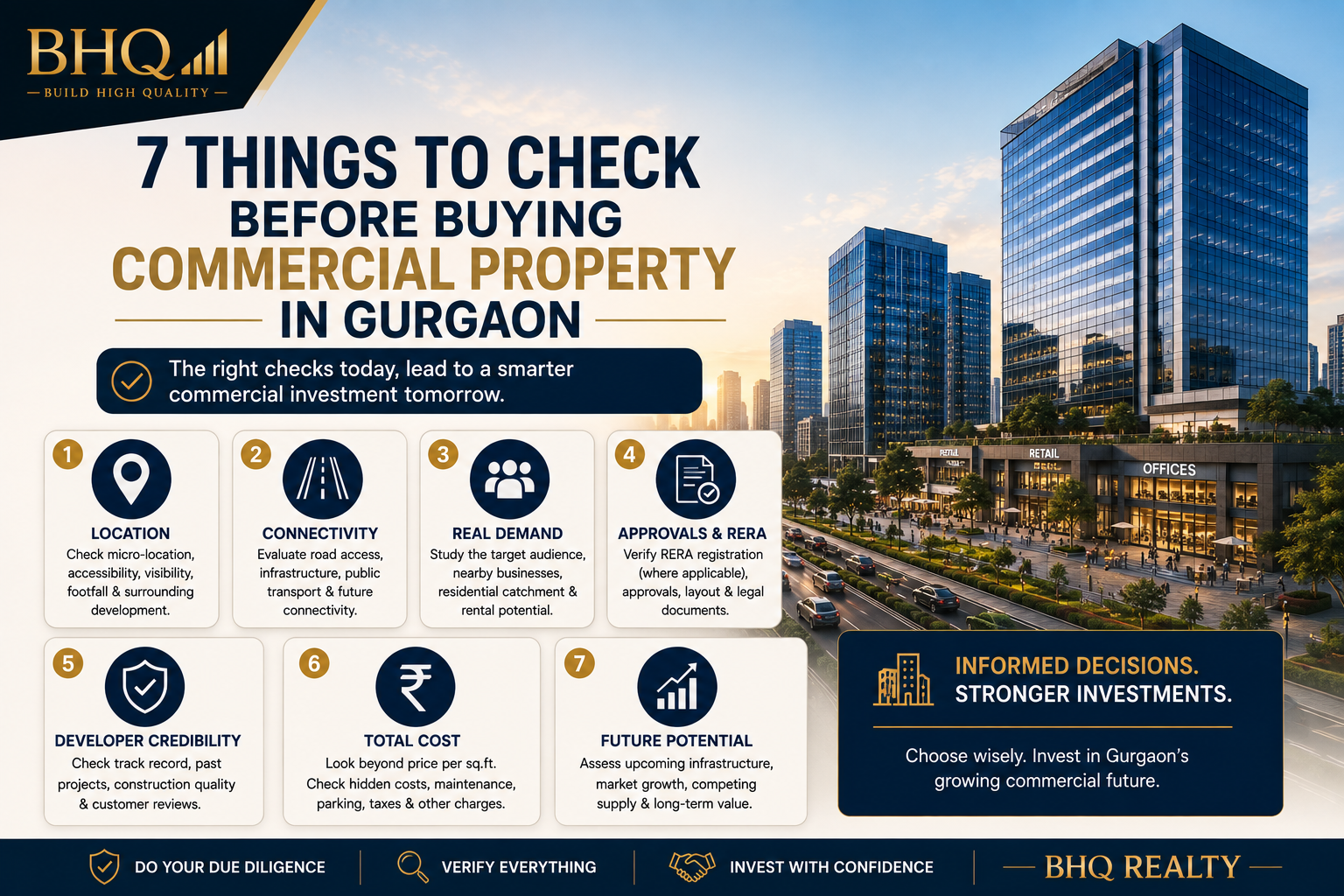
Whether you're considering an office, retail unit, shop, showroom or another commercial asset, here are seven important things to check before buying commercial property in Gurgaon.
1. Start With the Location But Go Beyond the Sector Number
"Sector 7", "Sector 70", "Sector 84" or any other sector number tells you very little on its own.
The actual commercial potential of a property depends on its micro-location.
Two properties within the same sector can have completely different commercial characteristics.
One may have:
- Better road access
- Stronger visibility
- Better frontage
- More surrounding development
- Better parking
- Higher customer movement
while another may be relatively difficult to access.
Therefore, when evaluating commercial property in Gurgaon, look beyond the address.
Check:
- Approach roads
- Main-road visibility
- Internal connectivity
- Entry and exit points
- Nearby residential communities
- Existing businesses
- Office clusters
- Retail activity
- Parking
- Public transportation
- Surrounding development
A commercial property should be evaluated from the perspective of the people who will actually use it.
2. Understand Connectivity and Infrastructure
Infrastructure can significantly influence commercial accessibility.
Gurgaon's evolving network of roads, expressways and public transportation continues to reshape how people move across the city.
Important corridors include:
- NH-48
- Dwarka Expressway
- Southern Peripheral Road
- Golf Course Road
- Golf Course Extension Road
- Sohna Road
But investors should make an important distinction between existing infrastructure and proposed infrastructure.
A proposed road or metro connection may eventually improve accessibility, but it should not automatically be treated as a current benefit.
Ask:
- What is operational today?
- What is actually under construction?
- What is only proposed?
- What is the expected impact on this specific location?
This approach can help separate genuine infrastructure advantages from marketing narratives.
3. Study the Real Demand
This is perhaps the most important question:
Who will use the property?
A commercial property needs a real customer or tenant base.
For an office:
Which businesses are likely to lease or occupy it?
For retail:
Who are the target customers?
For a restaurant:
Is there enough relevant footfall and catchment?
For a neighbourhood commercial project:
Is there sufficient residential population nearby?
This is why simply hearing that "Gurgaon is growing" is not enough.
You need to understand the specific demand drivers around the property.
Look at:
- Residential population
- Office population
- Nearby companies
- Existing retailers
- Customer demographics
- Daily movement
- New developments
- Competing commercial projects
A strong commercial property is ultimately supported by people and businesses.
4. Check RERA and Project Approvals
Legal and regulatory due diligence should never be treated as an afterthought.
For eligible projects, buyers should verify the project's RERA registration and available project information through the relevant authority.
Haryana RERA provides an online registered-project database where buyers can review project registration details, project location, promoter information, registration validity and other available records. (haryanarera.gov.in)
The authority's database also shows that projects in Gurugram continue to receive registrations and approvals, demonstrating why buyers should verify the specific project rather than relying solely on promotional material. (haryanarera.gov.in)
Buyers should verify relevant documents such as:
- RERA registration
- Project approvals
- Promoter details
- Development permissions
- Land-related documentation
- Approved plans
- Completion/occupancy documentation where applicable
- Project status
- Applicable commercial-use permissions
The exact documents required can vary according to the project and transaction structure.
For a significant purchase, buyers should have the documents independently reviewed by a qualified legal professional.
5. Evaluate the Developer, Not Just the Property
A commercial property can have an excellent location and attractive design.
But execution matters.
The developer is responsible for turning the concept into a functioning asset.
Before buying, research:
Track Record
What projects has the developer completed?
Delivery
Were previous projects delivered as promised?
Construction Quality
What is the actual quality of completed developments?
Transparency
Are project details and commercial terms clearly communicated?
Maintenance
How will the property be maintained after possession?
Customer Experience
Does the developer have a reputation for addressing buyer concerns?
This is particularly important for commercial property because the asset's performance can depend heavily on the quality of the overall development.
A good commercial destination is more than an individual unit.
It is an ecosystem.
6. Don't Look Only at the Price Per Square Foot
Price per square foot is one of the first numbers buyers look at.
But it should not be the only number.
Consider the total cost of ownership.
This can include:
- Base property price
- PLC or location-related charges, where applicable
- Parking
- Maintenance deposits
- Taxes
- Registration and transaction costs
- Fit-out costs
- Financing costs
- Maintenance
- Property management charges
- Vacancy-related costs
The cheapest property is not necessarily the best value.
Similarly, the most expensive property is not automatically the best investment.
The real question is:
What commercial value am I receiving for the total cost?
7. Think About the Future, Not Just Today's Market
Real estate is a long-term asset.
A commercial property should therefore be evaluated not only on current conditions but also on its ability to remain relevant.
Ask:
- What is being developed around the property?
- Will the surrounding population increase?
- Are new offices coming nearby?
- Will infrastructure improve accessibility?
- Is competing commercial supply increasing?
- Will the project still be attractive five or ten years from now?
Future relevance does not mean making guaranteed predictions.
Markets change.
Infrastructure can be delayed.
Demand can shift.
New competing developments can emerge.
But understanding the broader development pipeline can help buyers make more informed decisions.
Office, Retail or Mixed-Use: Choose the Right Format
Not all commercial properties work in the same way.
Office
Office property generally depends on:
- Business demand
- Employee accessibility
- Building quality
- Floor efficiency
- Parking
- Connectivity
- Workplace amenities
Retail
Retail generally depends more heavily on:
- Visibility
- Catchment
- Customer movement
- Frontage
- Accessibility
- Parking
- Surrounding businesses
Mixed-Use
Mixed-use developments can combine:
- Offices
- Retail
- Restaurants
- Lifestyle
- Services
These developments can create broader ecosystems, but they still need to be evaluated based on the specific project and market.
Don't Confuse Footfall With Commercial Success
High footfall is often used as a selling point for retail properties.
But footfall alone does not guarantee business success.
The quality of footfall matters.
For example, a location may have significant pedestrian movement but limited relevance to a premium fashion retailer.
Another location may have lower overall movement but a highly relevant customer base.
Therefore, ask:
- Who are the people visiting?
- Why are they visiting?
- How often do they visit?
- Does their profile match the businesses expected to operate here?
This is much more meaningful than simply looking at a footfall number.
Site Visits Matter
Digital brochures and virtual presentations are useful.
But nothing replaces a physical site visit.
Visit the property at different times.
Visit during:
- Morning
- Afternoon
- Evening
- Weekdays
- Weekends
Observe:
- Traffic
- Parking
- Accessibility
- Customer movement
- Nearby businesses
- Construction activity
- Noise
- Surrounding development
- Entry and exit
- Overall environment
A location can look very different at 11 AM on a weekday compared with 7 PM on a weekend.
Ask the Right Questions Before Booking
Before committing to a commercial property, buyers should get clear answers to questions such as:
About the project
- What is the exact project status?
- What approvals are in place?
- Is the project RERA registered where applicable?
- What is the expected completion timeline?
About the unit
- What is the carpet area?
- What is the saleable/super area?
- What is the exact unit location?
- What is the frontage?
- What are the common-area arrangements?
About costs
- What is the total acquisition cost?
- Are there additional charges?
- What are the maintenance costs?
- What are the parking charges?
About usage
- What businesses are permitted?
- Are there restrictions on usage?
- What signage rights apply?
- What are the operating-hour provisions?
About the development
- Who will manage the property?
- What amenities are planned?
- How will common areas be maintained?
Getting these details in writing is preferable to relying on verbal assurances.
Beware of Guaranteed Return Claims
Commercial property marketing sometimes focuses heavily on projected rental income or appreciation.
Buyers should approach such claims carefully.
Actual performance can depend on:
- Occupancy
- Tenant demand
- Rental market conditions
- Vacancy
- Maintenance
- Property management
- Competition
- Economic conditions
A projected return is not the same as a guaranteed return.
Before making a decision, investors should understand the assumptions behind any financial projection and seek independent financial or legal advice where appropriate.
Why Due Diligence Matters in Gurgaon
Gurgaon offers substantial commercial opportunities, but it is also a complex real estate market.
Different micro-markets have different:
- Development stages
- Customer profiles
- Infrastructure
- Supply levels
- Business ecosystems
- Pricing
- Commercial formats
A property that works well in one corridor may not work equally well in another.
This makes local market understanding particularly valuable.
BHQ Realty's Approach
BHQ Realty positions itself around Gurgaon-focused real estate expertise, with its current offering including private developments, builder floors, commercial property consulting and investor deal structuring. BHQ Realty
The company's approach highlights market understanding, property shortlisting, site-visit support, transparent guidance and coordination through the buying process.
As BHQ Realty prepares to bring its first commercial project in Gurgaon, these principles become even more relevant.
The objective is not simply to offer commercial space.
It is to understand the relationship between:
Location + Infrastructure + Demand + Design + Business Potential
That combination is what creates a commercially meaningful destination.
A Simple Commercial Property Checklist
Before making a decision, ask yourself:
- ✓ Is the location accessible?
- ✓ Is there genuine demand?
- ✓ Is the surrounding development supportive?
- ✓ Is the project appropriately approved and registered where required?
- ✓ Have I checked the developer's track record?
- ✓ Do I understand the complete cost?
- ✓ Is the property suitable for its intended use?
- ✓ Have I compared competing projects?
- ✓ Have I physically visited the site?
- ✓ Have I considered future supply and infrastructure?
- ✓ Have I independently verified important documents?
If you cannot confidently answer these questions, more due diligence may be needed before proceeding.
Final Thoughts
Buying commercial property in Gurgaon can be an important financial decision.
The city offers a diverse commercial ecosystem, strong business activity and continuously evolving infrastructure. But opportunities should be evaluated carefully rather than based solely on location names, promotional claims or expected returns.
The best approach is to look at the complete picture.
Study the micro-market.
Understand the users.
Evaluate connectivity.
Verify approvals.
Research the developer.
Calculate the complete cost.
Visit the site.
Compare alternatives.
And think about long-term relevance.
Because the right commercial property is not simply the one with the most attractive brochure.
It is the one where location, demand, quality, accessibility and commercial fundamentals come together.
For BHQ Realty, that philosophy is central to the company's journey toward its first commercial development in Gurgaon.
Build high quality. Build with purpose. Build for the future.
Frequently Asked Questions
What should I check before buying commercial property in Gurgaon?
The key factors include location, connectivity, demand, project approvals, RERA registration where applicable, developer credibility, total acquisition cost, property usage, competing supply and long-term market potential.
Is RERA registration important for commercial property?
Where RERA applies to a project, buyers should verify the project's registration and available records with the relevant authority. Haryana RERA maintains an online database of registered projects in Gurugram and across Haryana. (haryanarera.gov.in)
Is location important for commercial property?
Yes. However, investors should evaluate the exact micro-location, accessibility, catchment, visibility, surrounding development and infrastructure rather than relying only on the sector name.
Should I invest in office or retail property?
It depends on your objectives and the specific property. Office demand is generally linked to businesses and employees, while retail depends more heavily on customer catchment, visibility and relevant footfall.
Is a high projected rental return guaranteed?
No. Actual rental performance can vary based on occupancy, tenant demand, market conditions, maintenance, vacancy and competing supply. Investors should independently verify financial projections.
Why should I conduct a site visit?
A physical site visit allows you to evaluate access, traffic, parking, visibility, surrounding development and customer movement factors that may not be fully apparent from brochures or online listings.